
Spider Monkey
Ateles geoffroyiC tier · Capable116th of 163 mammals
Size & speed

- Weight
- 7.5 kg17 lb
- Length
- 50 cm19.7 in
As heavy as 1.7 house cats
Heavier than 43% of animalsAbout 1.7 rulers long
Bigger than 23% of animalsA long-limbed, thumbless acrobat of Central American rainforests, Geoffroy's spider monkey swings beneath branches and hangs by a tail that works like a fifth hand. It is clever and socially coordinated, but at about 7.5 kg it relies on height, speed and branch-shaking threats rather than fighting power.
Detailed ratings
Research-backed ratings on one 0–100 scale for all 344 animals (updated 2026-09-28). How ratings work


Card No. 207 of 344. Every animal on Animal Battle Stats has one: its power, tier and archetype on the front; its six battle stats, abilities and signature move on the back.
Special abilities
The prehensile tail has a bare, ridged pad near the tip and can hold the monkey's full weight, so it can hang, feed and grab with its hands free. In a fight it can stay anchored in a branch while its arms and teeth work.
When threatened from below it barks, shakes branches, and breaks off and drops limbs of up to 4 kg towards the intruder, letting it harass a ground opponent without coming within reach.
Unique traits
The thumb is reduced to a tiny stub and the long fingers form hooks, a hand shape suited to swinging under branches rather than fine manipulation.
Adult males sometimes leave the trees and move single file on the ground in unusual silence into neighbouring ranges, a behaviour otherwise best known from chimpanzees.
How it fights
Weapons
- The spider monkey's weapons are its bite and its grip. It is a fruit-eater, not a predator, so it has no killing technique for prey. Aggression is aimed mostly at other spider monkeys. On Barro Colorado Island, Panama, three coalitionary attacks by adult males on subadult males were recorded, two followed by the victim's disappearance and presumed death (Campbell 2006). In Yucatán, Mexico, a young adult male that had been repeatedly injured was killed by at least one adult male in an intragroup attack (Valero et al. 2006). These show that males can inflict fatal injuries when several gang up on one victim, but in a one-on-one fight a slender 7.5 kg monkey has little power.
Struggles vs
- Low absolute mass and power.
- No armor and a slender, long-limbed frame.
- Lethal aggression depends on coalitions; alone it has only a bite and a grip.
- Much weaker on the ground, where pumas have killed adults (Busia et al. 2018).
- Weight
- 7.5 kg17 lb
- Height
- No reliable measurement
- Length
- 50 cm19.7 in
- Top speed
- No reliable measurement
- Bite force
- No reliable measurement
- Lifespan
- 27 years
- Home biome
- Jungle
- Lifestyle
- Social
Rated specimen: Healthy mature adult male, 7.5 kg, near the Animal Diversity Web average adult mass (7.27 kg) and in the middle of the 6–9 kg range given by Wikipedia.
Fun facts
- The genus name Ateles means "imperfect", referring to the missing thumb.
- The tail pad has skin ridges similar to fingerprints.
- Spider monkeys have dropped branches of up to 4 kg on people who followed them.
- They sometimes rub a mix of saliva and crushed lime leaves into their fur, which is thought to repel insects.
- Adults stretch across gaps in the canopy to form bridges for their young.
- Female spider monkeys have an enlarged, dangling clitoris that sometimes leads observers to mistake them for males.
Closest rivals by power. Tap one for the full breakdown, or pick any opponent.
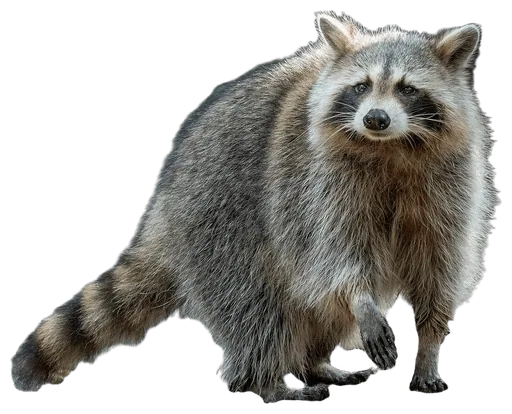
vs Naked Mole RatWins · 76% · Clear edge 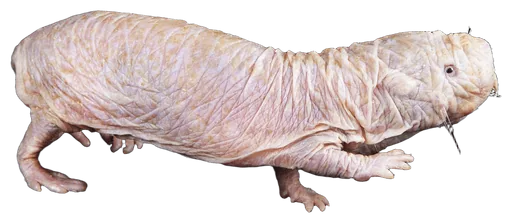 W vs RaccoonWins · 51% · Toss-up
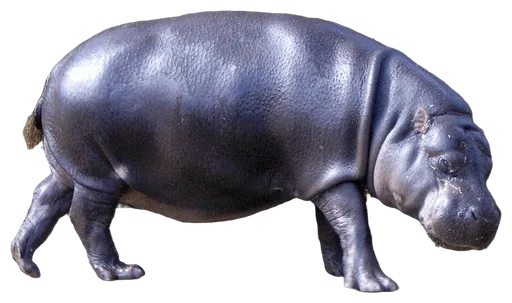
 W vs Pygmy HippopotamusLoses · 70% · Clear edge
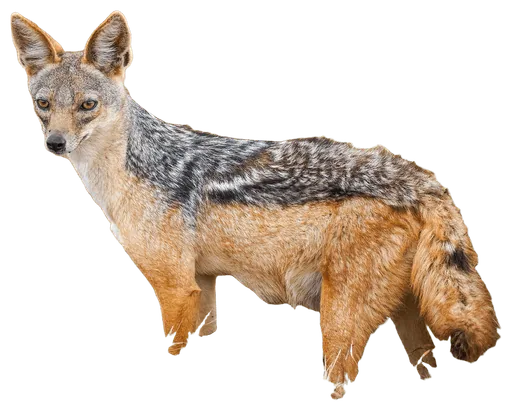
 L vs JackalDraw · 50-50 · Dead even
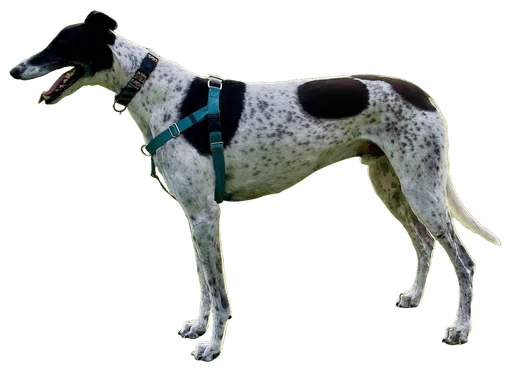
 D vs GreyhoundLoses · 57% · Toss-up
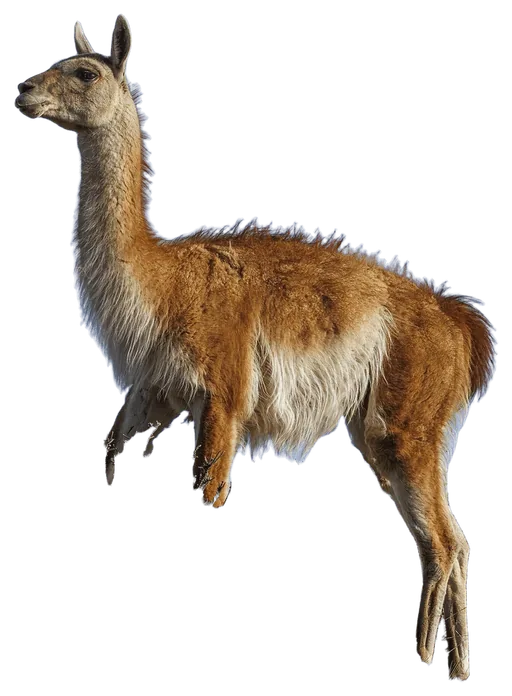
 L vs GuanacoLoses · 67% · Slight edge
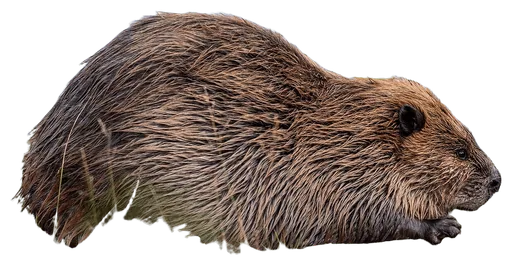
 L vs BeaverLoses · 59% · Slight edge
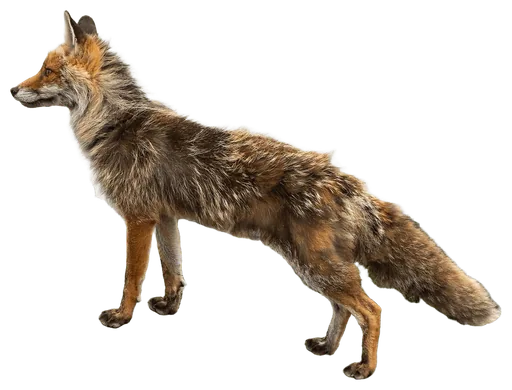
 L vs Red FoxLoses · 52% · Toss-up
 L
Spider Monkey battle analysis
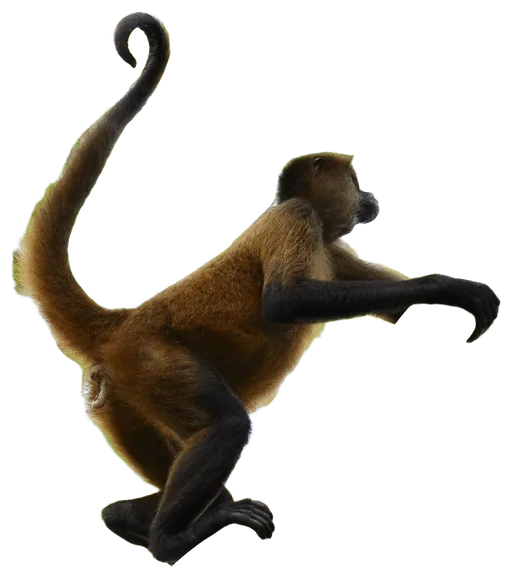
Geoffroy's spider monkey is built for hanging. Its arms are a quarter longer than its legs, its thumb has shrunk to a tiny stub, and its long fingers curl into hooks that clip over branches as it swings. Its tail is stronger still: bare and ridged near the tip, it can hold the monkey's entire weight, pick fruit and scoop water, leaving the hands free.
Its social life is just as unusual. Communities of 20 to 42 animals rarely gather in one place; instead they split into small, shifting parties that forage separately and reunite with embraces that calm the tension of meeting. The males, who stay in the group they were born into, are bonded allies. They have been seen leaving the canopy to walk single file and silent into a neighbouring range, and on rare occasions groups of males have fatally attacked a younger male of their own community.
In a matchup, the spider monkey is fast, hard to reach and smart, but light. Its best defense is to climb out of range, bark, shake branches and drop heavy limbs on whatever is below. If a big cat, a large eagle or a heavy predator catches it, a slender 7.5 kg frame with only a bite and a grip gives it little chance.
Habitat & range
Southern and eastern Mexico south through Guatemala, Belize, El Salvador, Honduras, Nicaragua and Costa Rica to Panama, and possibly a small part of Colombia. It lives in rainforest, semideciduous forest and mangrove, mostly in the upper canopy, with the highest densities in evergreen forest. It needs large tracts of forest.
Diet & hunting
Mainly ripe, fleshy fruit (70–80% of feeding time), with young leaves supplying protein, plus flowers, bark, insects, honey, seeds and buds. It gets much of its water from fruit and leaves and drinks from tree holes and bromeliads, and unlike other spider monkeys it also drinks from ground water. By swallowing fruit whole and passing the seeds, spider monkeys spread the seeds of many forest trees.
Social life
Fission–fusion communities of 20–42 members that break into small subgroups during the day. Males stay in their birth group and form strong bonds; females move to other groups at maturity. Each monkey has a distinctive whinny, which may allow individuals to recognise each other by voice alone.
Conservation
Listed as Endangered by the IUCN (2021 assessment), mainly because of habitat loss, hunting and capture for the pet trade. Its slow reproduction means populations recover slowly. It was wiped out by hunting on Barro Colorado Island, Panama, by 1912; a reintroduction in 1959–1966 left one male and four females, which grew to 28 monkeys by 2003.
Quick answers
How strong is a Spider Monkey?
On the Animal Battle Stats scale, the Spider Monkey has an attack rating of 26 and a power index of 48 out of 100, which ranks it #207 of 344 animals and puts it in C tier (Capable). Its strongest stat is agility (91).
How much does a Spider Monkey weigh?
A typical adult Spider Monkey weighs about 7.5 kg (17 lb). Rated specimen: healthy mature adult male, 7.5 kg, near the Animal Diversity Web average adult mass (7.27 kg) and in the middle of the 6–9 kg range given by Wikipedia.
How fast is a Spider Monkey?
There is no reliable measured top speed for the Spider Monkey, so we do not publish one. Its agility rating, which covers acceleration, reflexes and evasion, is 91 out of 100.
What does a Spider Monkey eat?
Mainly ripe, fleshy fruit (70–80% of feeding time), with young leaves supplying protein, plus flowers, bark, insects, honey, seeds and buds. It gets much of its water from fruit and leaves and drinks from tree holes and bromeliads, and unlike other spider monkeys it also drinks from ground water. By swallowing fruit whole and passing the seeds, spider monkeys spread the seeds of many forest trees.
Is the Spider Monkey endangered?
The Spider Monkey's conservation status is Endangered. Listed as Endangered by the IUCN (2021 assessment), mainly because of habitat loss, hunting and capture for the pet trade. Its slow reproduction means populations recover slowly. It was wiped out by hunting on Barro Colorado Island, Panama, by 1912; a reintroduction in 1959–1966 left one male and four females, which grew to 28 monkeys by 2003.
What animals can beat a Spider Monkey?
Among its closest rivals, the Pygmy Hippopotamus (70%), the Greyhound (57%), the Guanaco (67%), the Beaver (59%), the Red Fox (52%) would be favored against the Spider Monkey. It would be favored against the Naked Mole Rat, the Raccoon. It is dead even with the Jackal: a draw.
Researched 2026-09-28. Ratings are editorial judgments built from these sources; measurements describe a healthy adult male.
- Wikipedia, Geoffroy's spider monkeymass, length, tail, limbs, locomotion, day range, groups, calls, diet, predators, reproduction, captive lifespan, IUCN status
- Wikipedia, Spider monkey (genus)tail pad, branch dropping, brain size, typical lifespan, cognition ranking
- Animal Diversity Web, Ateles geoffroyimass, length, agility, displays, reproduction, captive lifespan
- Campbell 2006, American Journal of Primatologylethal male coalitionary aggression
- Valero et al. 2006, American Journal of Primatologylethal intragroup aggression
- Aureli et al. 2006, American Journal of Physical Anthropologyraiding parties, tactics
- Aureli and Schaffner 2007, Biology Lettersconflict management
- Amici, Aureli and Call 2008, Current Biologycognition
- Deaner et al. 2007, Brain, Behavior and Evolutioncognition context
- Busia et al. 2018, Folia Primatologicapredators
- Schaffner and Aureli 2026, Folia Primatologicasocial bonding behaviour
Photo: “Central american spider monkey natural lodge caño negro 4.17.25 monkeys DSC 9525-topaz-rawdenoise.jpg” by lwolfartist, CC BY 2.0, background removed and cropped. Original
Suggest a correction