
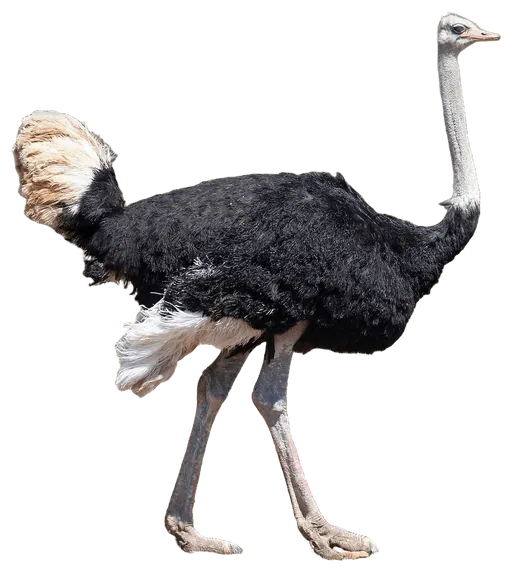
Ostrich
Struthio camelusB tier · Strong1st of 55 birds
Size & speed

- Weight
- 130 kg287 lb
- Length
- 2.5 m8.2 ft
- Top speed
- 69 km/h43 mph
As heavy as 1.9 people
Heavier than 75% of animals1.4× a person's height
Bigger than 79% of animals1.5× Usain Bolt's top speed
Faster than 90% of animalsThe Common Ostrich is the world's largest living bird and an exceptional terrestrial athlete. A prime male around 130 kg combines near-70 km/h sprinting, economical endurance running, rapid cutting maneuvers and a long clawed counter-kick. Its weakness is passive defense: it has no armor and relies on vigilance, spacing and mobility to keep dangerous opponents away from its exposed legs and neck.
Detailed ratings
Research-backed ratings on one 0–100 scale for all 344 animals (updated 2026-09-27). How ratings work


Card No. 61 of 344. Every animal on Animal Battle Stats has one: its power, tier and archetype on the front; its six battle stats, abilities and signature move on the back.
Special abilities
The long hindlimb can deliver a dangerous forward defensive strike ending in the enlarged third-toe claw, giving a standing adult substantial reach and lacerating potential.
Specialized pelvic-limb muscles and long distal tendons store and return elastic energy, supporting unusually economical high-speed running and sustained pursuit escape.
Unique traits
The ostrich is the only living bird with just two toes on each foot; pressure studies show the main claw is an important high-speed traction element.
Despite being the heaviest living bird, experimental biomechanics show ostriches can execute rapid running turns through specialized limb geometry and control.
How it fights
Weapons
- The ostrich is a leg-dominant fighter. A mature male has much greater absolute mass and leg reach than an emu, and the main third toe carries a long, sharp claw. Institutional zoological sources explicitly describe the kick as capable of killing a large predator, but the report does not convert that qualitative warning into an unsupported force number. Practical offense depends on maintaining enough spacing to extend the leg and connect with the clawed foot.
Struggles vs
- Dense vegetation or confined spaces restrict long-stride running and kick spacing.
- Slippery or unstable footing reduces traction and the value of cursorial specialization.
- Grapplers that get behind or underneath the kicking arc can attack exposed legs/neck.
- The bird lacks armor and has no strong close-range jaw weapon if knocked down.
- Weight
- 130 kg287 lb
- Height
- 2.5 m8.2 ft
- Length
- 2.5 m8.2 ft
- Top speed
- 69 km/h43 mph
- Bite force
- No reliable measurement
- Lifespan
- 35 years
- Home biome
- Savanna
- Lifestyle
- Social
Rated specimen: Healthy prime fully mature male, 130.0 kg, approximately 250.0 cm standing height and 250.0 cm overall head-to-body/tail reference length.
Fun facts
- Ostriches are the tallest and heaviest living birds.
- They are the only living birds with only two toes on each foot.
- Their eyes are about 5 cm across, among the largest eyes of any land animal.
- An ostrich egg can weigh around 1.5 kg.
- Peer-reviewed work shows the main toe claw contributes to traction during fast running, not only defense.
- Experimental biomechanics documents rapid cutting maneuvers in this giant biped.
Closest rivals by power. Tap one for the full breakdown, or pick any opponent.
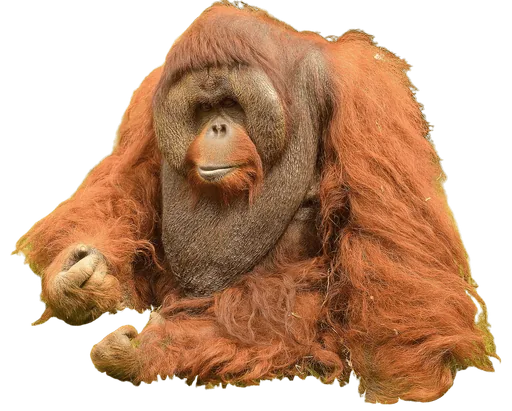
vs SailfishWins · 54% · Toss-up 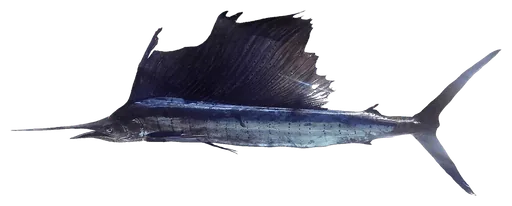 W vs OrangutanWins · 52% · Toss-up
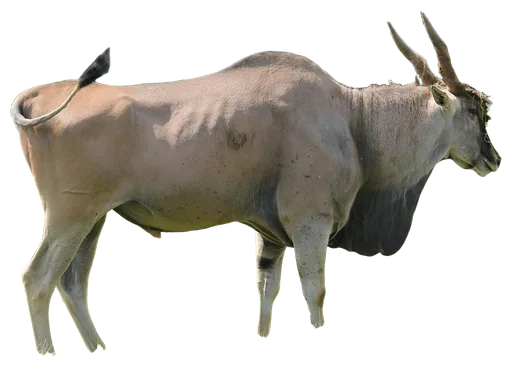
 W vs Common ElandLoses · 59% · Slight edge
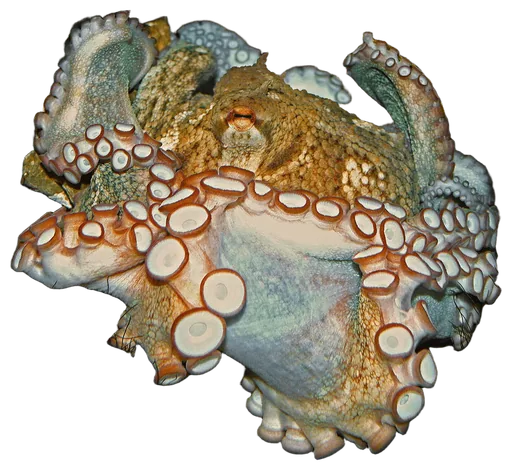
 L vs OctopusWins · 58% · Slight edge
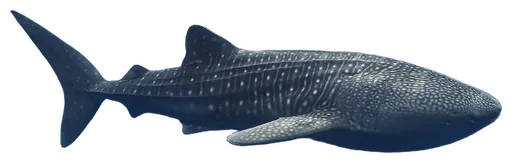
 W vs Whale SharkLoses · 76% · Clear edge
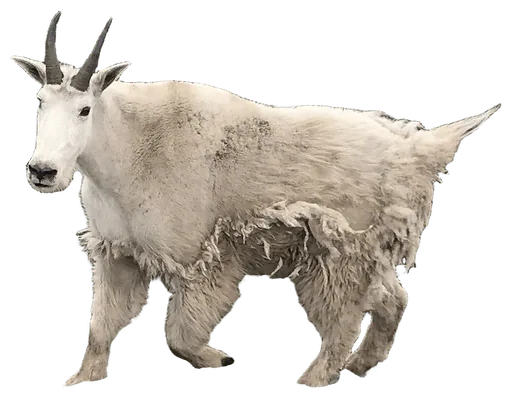
 L vs Mountain GoatWins · 52% · Toss-up
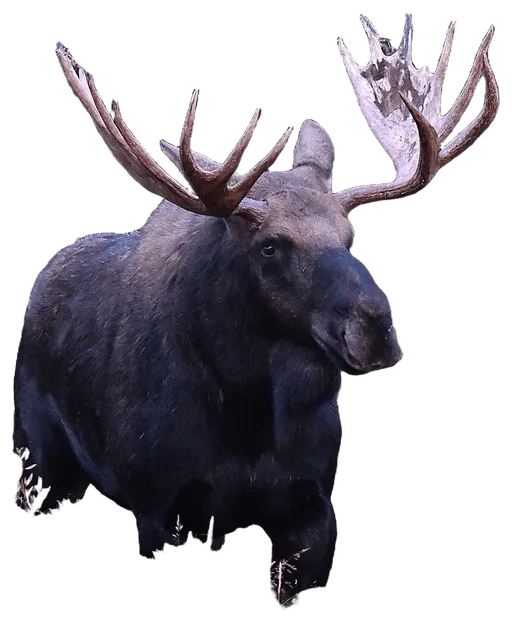
 W vs MooseLoses · 57% · Toss-up
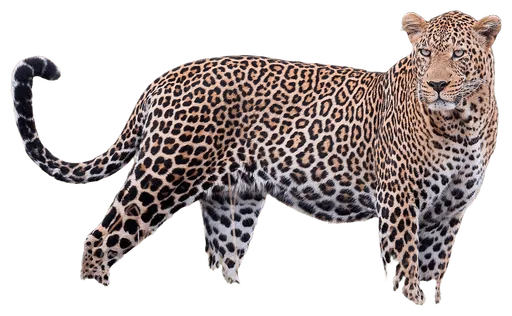
 L vs LeopardWins · 55% · Toss-up
 W
Ostrich battle analysis
The ostrich is not simply a very large flightless bird. Its anatomy is a highly specialized terrestrial locomotor system. Long distal limbs reduce unnecessary mass, proximal muscles generate and control force, and elastic tendons recycle mechanical energy. Its unusual two-toed foot places the large third toe and claw directly into the running system, where pressure measurements show the claw contributes traction at push-off. The same structure becomes dangerous when a cornered adult kicks.
This makes the ostrich unusually difficult to summarize with top speed alone. Controlled studies show that it can turn sharply while running, and energetics research demonstrates economical sustained locomotion. Those findings justify high Agility and Stamina independently. The 130 kg canonical male is also large enough that its kick is a serious absolute weapon, but the ABS scale still keeps it below more massive horned ungulates and far below megafauna.
The tradeoff is protection. The ostrich survives by seeing danger, creating distance and controlling engagement range. Feathers are not armor, and the neck and legs are conspicuous targets. If a large predator secures a flank or rear grapple, much of the bird's specialized running geometry is neutralized. Its battle profile is therefore a mobile counter-striker rather than a tank.
Habitat & range
Common Ostriches inhabit open grasslands, savannas, shrublands, semi-deserts and open woodlands across parts of sub-Saharan Africa. Open visibility and firm terrain strongly complement their vigilance and cursorial escape strategy.
Diet & hunting
They are predominantly herbivorous omnivores, taking grasses, seeds, leaves, roots, flowers, fruits and succulent plants while opportunistically eating insects and small vertebrates. Their large body and terrestrial foraging make them important consumers in open African systems, but they are not pursuit predators.
Social life
Groups commonly contain a dominant male and dominant female plus additional birds. Smithsonian describes herds around a dozen individuals, sometimes much larger, while ADW describes breeding territories and smaller groups outside the breeding period. Group vigilance improves predator detection but is not counted as multiplied combat power for the individual profile.
Conservation
The Common Ostrich is generally listed as Least Concern, although local populations and subspecies can face habitat loss, hunting, egg collection and regional declines. The historical range was broader than the modern distribution.
Quick answers
How strong is an Ostrich?
On the Animal Battle Stats scale, the Ostrich has an attack rating of 58 and a power index of 61.3 out of 100, which ranks it #61 of 344 animals and puts it in B tier (Strong). Its strongest stat is stamina (89).
How much does an Ostrich weigh?
A typical adult Ostrich weighs about 130 kg (287 lb). Rated specimen: healthy prime fully mature male, 130.0 kg, approximately 250.0 cm standing height and 250.0 cm overall head-to-body/tail reference length.
How fast is an Ostrich?
The Ostrich's top speed is about 69 km/h (43 mph). Its agility rating is 83 out of 100.
What does an Ostrich eat?
They are predominantly herbivorous omnivores, taking grasses, seeds, leaves, roots, flowers, fruits and succulent plants while opportunistically eating insects and small vertebrates. Their large body and terrestrial foraging make them important consumers in open African systems, but they are not pursuit predators.
Is the Ostrich endangered?
No. The Ostrich is listed as Least Concern. The Common Ostrich is generally listed as Least Concern, although local populations and subspecies can face habitat loss, hunting, egg collection and regional declines. The historical range was broader than the modern distribution.
What animals can beat an Ostrich?
Among its closest rivals, the Common Eland (59%), the Whale Shark (76%), the Moose (57%) would be favored against the Ostrich. It would be favored against the Sailfish, the Orangutan, the Octopus, the Mountain Goat, the Leopard.
Researched 2026-09-27. Ratings are editorial judgments built from these sources; measurements describe a healthy adult male.
- Smithsonian National Zoo, Ostrichmass, height, speed, lifespan, habitat, reproduction
- San Diego Zoo, Ostrichsexual dimorphism, life history, vision, ecology
- Chiba City Zoological Park, Common Ostrichsex-specific mass/height, diet, conservation
- Marwell Zoo, Ostrichspeed/endurance, claw, lifespan
- Jindrich et al. 2007, Mechanics of cutting maneuversagility, turning
- Rankin et al. 2016, pelvic-limb muscle roleslocomotor mechanics, tendon energy storage
- Watson et al. 2011, gait-specific energeticsstamina/running economy
- Rubenson et al. 2011, economical bipedal runningstamina, elastic mechanics
- Schaller et al. 2011, toe functionclaw length/function, endurance
- El-Gendy et al. 2012, toepad anatomyfoot cushioning
- ADW, Struthio camelusmass, social/reproductive behavior
- Guinness World Recordsexceptional ceiling only
- Wikimedia Commons, Ostrich male RWDimage provenance
- MSD Veterinary Manual adult male imageadult/sex reference
Photo: “Ostrich male RWD.jpg” by DickDaniels ( http://theworldbirds.org/ ), CC BY-SA 3.0, background removed and cropped. Original
Suggest a correction