
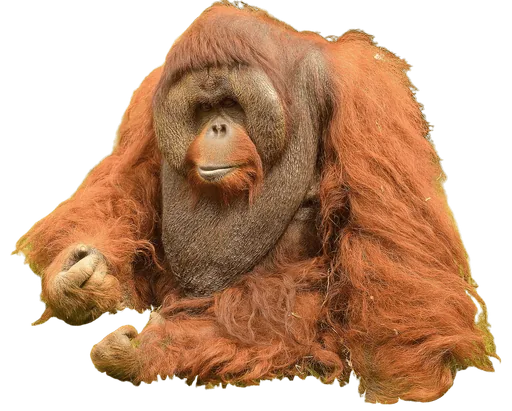
Orangutan
Pongo pygmaeusB tier · Strong34th of 163 mammals
Size & speed

- Weight
- 90 kg198 lb
- Height
- 97 cm38.2 in
About as heavy as a person
Heavier than 71% of animalsAbout 3.2 rulers tall
Bigger than 43% of animalsThe Bornean orangutan is a 90 kg flanged great ape whose battle strengths are long-reach grappling, large canines, four-limb canopy control and elite technical intelligence. It is formidable at close range and extraordinarily capable in forest structure, but lacks armor, sprint specialization and the dedicated killing weapons of large carnivores.
Detailed ratings
Research-backed ratings on one 0–100 scale for all 344 animals (updated 2026-09-27). How ratings work


Card No. 62 of 344. Every animal on Animal Battle Stats has one: its power, tier and archetype on the front; its six battle stats, abilities and signature move on the back.
Special abilities
Grasping hands and feet, very long arms and suspension let a Bornean orangutan distribute its weight across supports, alter elevation and maintain contact from multiple angles in forest terrain.
A mature male's enlarged throat sac amplifies long-distance calls carrying identity/context information and advertising travel direction or status, potentially deterring rivals before contact.
Unique traits
Sexually mature males can persist as smaller unflanged males or develop into much larger flanged males with cheek pads, throat sac and altered reproductive tactics.
Orangutans repeatedly construct structurally organized sleeping nests and select branches for different mechanical roles, demonstrating learned material handling and technical cognition.
How it fights
Weapons
- The jaw and canines are the primary tissue-damaging weapons. The upper limbs provide powerful pulling, grappling and positional control, while hands and feet can maintain multiple grips. A 90 kg flanged male has serious absolute strength, but this report does not use unsupported claims that orangutans are a fixed multiple of human strength. No direct force measurement recovered here supports such a multiplier.
- Weight
- 90 kg198 lb
- Height
- 97 cm38.2 in
- Length
- No reliable measurement
- Top speed
- No reliable measurement
- Bite force
- No reliable measurement
- Lifespan
- 50 years
- Home biome
- Jungle
- Lifestyle
- Mostly solitary
Rated specimen: 0 kg male because the larger mature male is the biologically relevant fighting specimen.
Fun facts
- Wild adult males can weigh 77-100 kg, roughly twice many adult females.
- Fully flanged males have large cheek pads and enlarged throat sacs used in long calls.
- A male's long call can contain information about identity and context and can advertise intended travel direction.
- Orangutans build sleeping nests from branches and leaves and make mechanically different choices for structural versus lining material.
- A wild Bornean female was shown through tooth chemistry to continue suckling until 8.1 years.
- Across long-term field sites, the mean orangutan interbirth interval was about 7.6 years.
Closest rivals by power. Tap one for the full breakdown, or pick any opponent.
vs Common ElandLoses · 62% · Slight edge 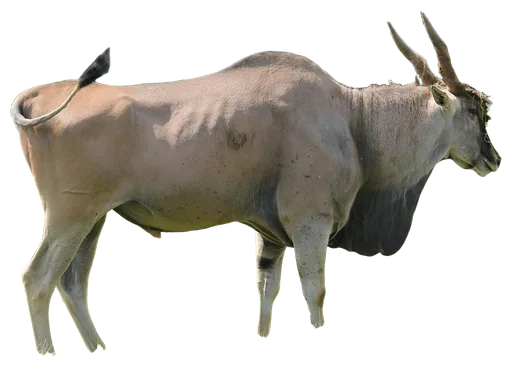 L vs Mountain GoatLoses · 51% · Toss-up
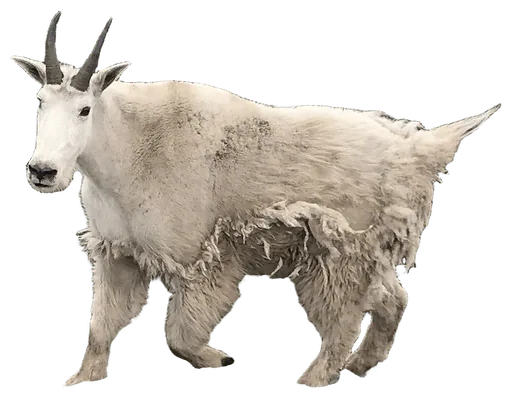 L vs MooseLoses · 60% · Slight edge
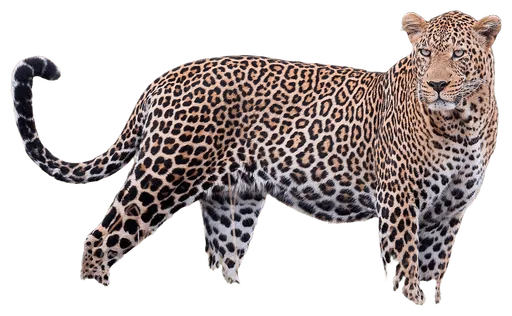
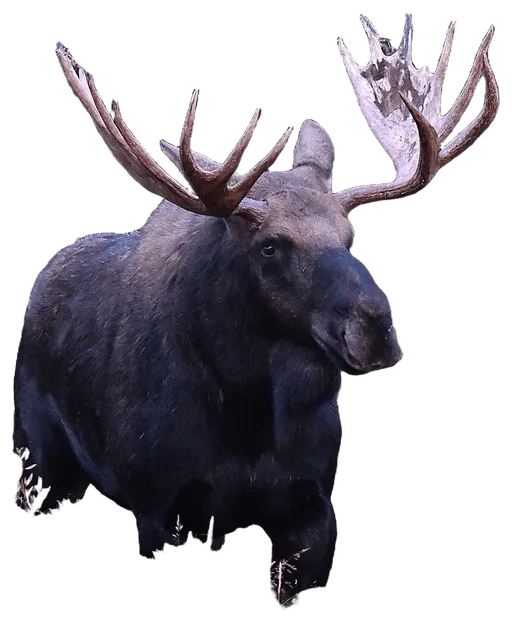 L vs LeopardWins · 53% · Toss-up
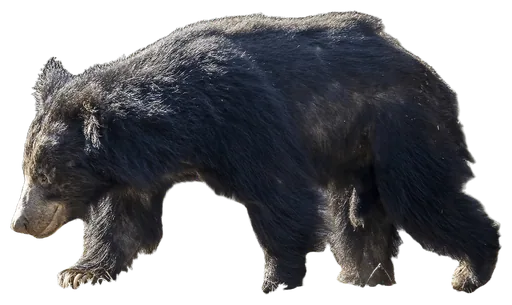
 W vs Sloth BearLoses · 51% · Toss-up
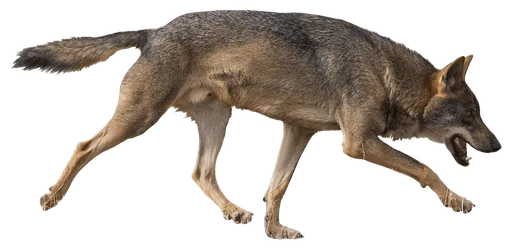
 L vs Gray WolfWins · 54% · Toss-up
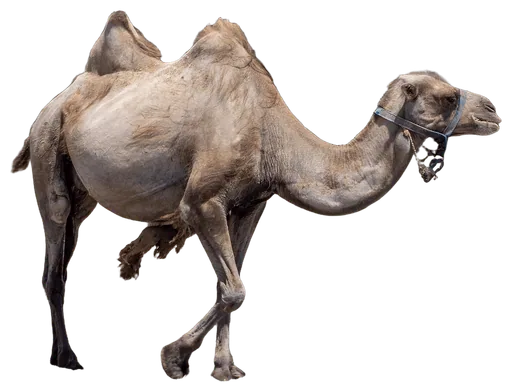
 W vs Bactrian CamelLoses · 59% · Slight edge
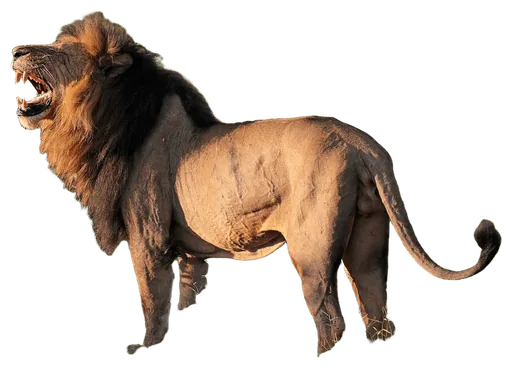
 L vs African LionLoses · 53% · Toss-up
 L
Orangutan battle analysis
A mature flanged Bornean orangutan is built around reach and control rather than pursuit. Its long arms, grasping hands and feet and powerful climbing musculature let it spread its weight across branches that would be precarious for a similarly heavy terrestrial mammal. In a canopy this produces a three-dimensional positional game: the ape can hang below supports, bridge gaps, climb vertically and maintain several points of contact while deciding where its mass can safely go next.
In direct conflict, however, the biology should not be exaggerated. The orangutan has large canines and serious grappling strength, but it is not a 90 kg big cat and it is not a scaled-up gibbon. There is no defensible basis here for viral claims that its strength is a fixed several-times-human multiplier, nor for a fabricated bite PSI. Its physical offense is therefore strong but not elite on a roster containing large bears, bovids, rhinos and megafauna.
Its most exceptional advantage is cognitive. Orangutans learn local foraging techniques, use tools, plan routes through mechanically complex canopy and construct sleeping nests from branches selected for different structural roles. Those abilities matter in a matchup because they support positioning, obstacle use and behavioral flexibility. They do not somehow increase muscle force, so they are concentrated in Intelligence/Tactics rather than copied into Attack and Special.
The flanged male also embodies an unusual reproductive strategy. Orangutan males can be sexually mature before developing the massive cheek pads, throat sac and body size of a flanged adult. Once flanged, the male broadcasts long calls that communicate over forest distances and can advertise identity, context and travel direction. The result is a fighter whose most impressive toolkit combines a large great-ape body with spatial control, signaling and technical cognition rather than armor or specialized predatory anatomy.
Habitat & range
Bornean orangutans are endemic to Borneo in Indonesia and Malaysia. They occupy tropical lowland and peat-swamp forests as well as some upland and montane forest. Smithsonian notes use from near sea level into mountainous forest. Forest structure is central to feeding, travel, nesting and safety.
Diet & hunting
They are predominantly fruit eaters, supplemented by leaves, bark, flowers, insects and other opportunistic foods. Fruit availability strongly influences travel and activity. As large frugivores they disperse seeds and affect forest regeneration.
Social life
Bornean orangutans are semi-solitary. Adult males are especially solitary, while female ranges may overlap and temporary feeding associations occur. Mature males communicate over long distances through long calls rather than maintaining chimpanzee-like cohesive parties.
Conservation
The Bornean orangutan is Critically Endangered. Major threats include forest loss and fragmentation, conversion for agriculture including oil palm, hunting, conflict killing and illegal capture. Its low reproductive rate magnifies the demographic effect of adult mortality.
Quick answers
How strong is an Orangutan?
On the Animal Battle Stats scale, the Orangutan has an attack rating of 57 and a power index of 61.1 out of 100, which ranks it #62 of 344 animals and puts it in B tier (Strong). Its strongest stat is intelligence (96).
How much does an Orangutan weigh?
A typical adult Orangutan weighs about 90 kg (198 lb). Rated specimen: 0 kg male because the larger mature male is the biologically relevant fighting specimen.
How fast is an Orangutan?
There is no reliable measured top speed for the Orangutan, so we do not publish one. Its agility rating, which covers acceleration, reflexes and evasion, is 75 out of 100.
What does an Orangutan eat?
They are predominantly fruit eaters, supplemented by leaves, bark, flowers, insects and other opportunistic foods. Fruit availability strongly influences travel and activity. As large frugivores they disperse seeds and affect forest regeneration.
Is the Orangutan endangered?
The Orangutan's conservation status is Critically Endangered. The Bornean orangutan is Critically Endangered. Major threats include forest loss and fragmentation, conversion for agriculture including oil palm, hunting, conflict killing and illegal capture. Its low reproductive rate magnifies the demographic effect of adult mortality.
What animals can beat an Orangutan?
Among its closest rivals, the Common Eland (62%), the Mountain Goat (51%), the Moose (60%), the Sloth Bear (51%), the Bactrian Camel (59%), the African Lion (53%) would be favored against the Orangutan. It would be favored against the Leopard, the Gray Wolf.
Researched 2026-09-27. Ratings are editorial judgments built from these sources; measurements describe a healthy adult male.
- Smithsonian National Zoo, OrangutanWild male 77-100 kg, female 36-54 kg; cautious arboreal locomotion; slow/awkward ground movement; habitat and communication
- Columbus Zoo, Bornean OrangutanMale 220-240 lb, female 120-130 lb, 4-5 ft standing, ~7 ft arm span
- Animal Diversity Web, Pongo pygmaeusBornean taxonomy and longevity synthesis
- Kunz et al. 2023, American Journal of PrimatologyMale bimaturism, flanged/unflanged behavioral tactics, flanged size, contest-avoidance context
- Nietlisbach et al. 2024, flanged male reproductive successFlanged males larger and higher reproductive success in wild population
- van Casteren et al. 2012, PNASNest construction, branch selection by structural function, technical know-how
- Fox et al. 2004, AJPAPopulation variation in tool use, diet and insect foraging
- Spillmann et al. 2017, long callsP. p. wurmbii male long calls encode individual/context information and travel direction
- Wich et al. 2019, slow ape7-site 7.6 y interbirth interval, ~15 y first reproduction, high immature survival
- Austin et al. 2017, Science AdvancesBornean female nursing to 8.1 y
- Henry Vilas Zoo, Bornean OrangutanUp to 2.4 m arm span; 35-45 y wild lifespan; CR status summary
- Wikimedia Commons, Male Bornean OrangutanMature male image identity, 5568x3712 resolution, CC BY-SA 2.0 provenance
Photo: “Male Orangutan - Rusti (9165300228).jpg” by Daniel Ramirez from Honolulu, USA, CC BY 2.0, background removed and cropped. Original
Suggest a correction