
Megalodon
Otodus megalodonS tier · Apex2nd of 51 sea creatures
Size & speed

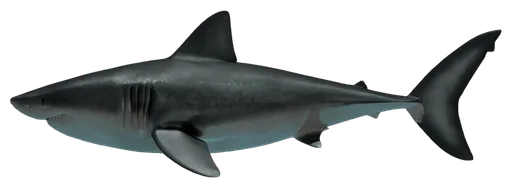
- Weight
- 30 t33.1 US tons
- Length
- 16.4 m53.8 ft
As heavy as 20 cars
Heavier than 99% of animals9.4× a person's height
Bigger than 99% of animalsMegalodon was a gigantic otodontid shark whose fossil teeth, vertebrae and geochemistry reveal a warm-bodied apex macropredator. A well-studied Belgian specimen is now reconstructed around 16.4 m and 30 t, armed with huge serrated teeth and a modeled bite capable of six-figure-newton forces. Its exact body form and maximum speed remain uncertain because no complete skeleton exists.
Detailed ratings
Research-backed ratings on one 0–100 scale for all 344 animals (updated 2026-09-27). How ratings work


Card No. 2 of 344. Every animal on Animal Battle Stats has one: its power, tier and archetype on the front; its six battle stats, abilities and signature move on the back.
Special abilities
Isotope evidence indicates a body warmer than ambient seawater, supporting sustained muscular performance and thermal independence beyond a fully ectothermic giant shark.
As a shark, Megalodon possessed the elasmobranch electroreceptive and lateral-line sensory systems, allowing detection of nearby bioelectric and water-movement cues even when vision was limited; exact sensitivity is unknown.
Unique traits
Enormous serrated teeth, at least 16 cm and possibly near 20 cm high, combine with gigantic modeled bite force to produce catastrophic cutting trauma.
The canonical fossil-based reconstruction places an active predatory shark around 16.4 m and 30 t, an exceptional combination of size and carnivorous trophic position.
How it fights
Weapons
- The primary weapon is an enormous jaw apparatus carrying multiple rows of very large serrated teeth. The weapon system combines huge absolute force, a broad bite, deep penetration and sawing edges. Secondary offense comes from 30 tonnes of body momentum and a powerful tail, but ramming is not independently demonstrated as a normal attack strategy and is not scored as a separate unrealistic weapon.
- Weight
- 30 t33.1 US tons
- Height
- No reliable measurement
- Length
- 16.4 m53.8 ft
- Top speed
- No reliable measurement
- Bite force
- No reliable measurement
- Lifespan
- 46 years
- Home biome
- Ocean
- Lifestyle
- Mostly solitary
Rated specimen: Large mature individual represented by Belgian vertebral specimen IRSNB P 9893, reconstructed in 2025 at approximately 16.4 m total length and 30,000 kg.
Fun facts
- The Belgian vertebral series used in the 2025 reconstruction is about 11 m long before the head and tail are added.
- The 2025 paper reconstructs that individual at roughly 16.4 m and 30 t, while a larger isolated Danish vertebra implies a possible 24.3 m / 94 t extreme.
- Megalodon teeth reach at least about 16 cm high and may approach 20 cm in exceptional cases.
- Nitrogen isotopes from tooth enameloid place megatooth sharks at exceptionally high trophic levels.
- Zinc-isotope data indicate Megalodon and great white populations could overlap in mean trophic position.
- The famous giant bite figure is a model estimate in newtons, not a direct fossil measurement and not a valid PSI value.
Closest rivals by power. Tap one for the full breakdown, or pick any opponent.
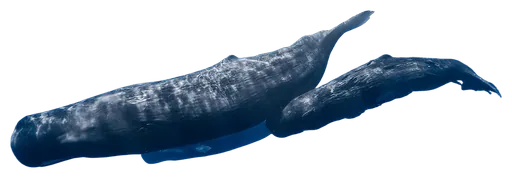
vs OrcaWins · 59% · Slight edge 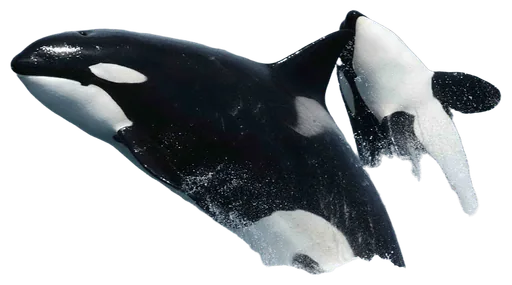 W vs Sperm WhaleWins · 54% · Toss-up
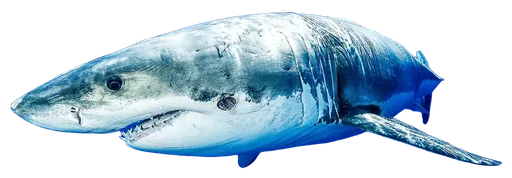
 W vs Great White SharkWins · 79% · Clear edge
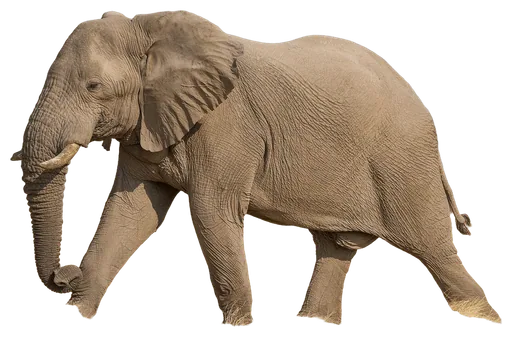
 W vs African ElephantWins · 69% · Slight edge
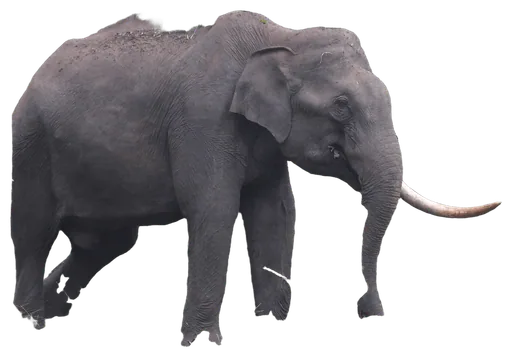
 W vs Asian ElephantWins · 73% · Clear edge
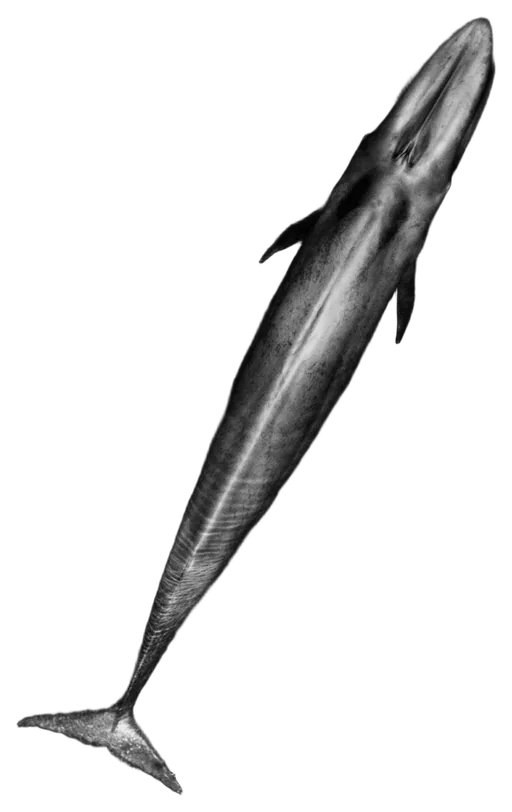
 W vs Blue WhaleWins · 60% · Slight edge
 W vs Humpback WhaleWins · 67% · Slight edge
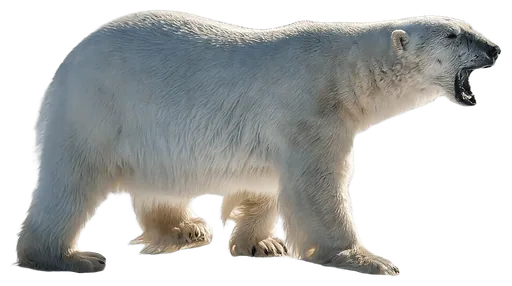
 W vs Polar BearWins · 85% · Decisive
 W
Megalodon battle analysis
Megalodon's ABS strength is not that every uncertain reconstruction should be maximized. It is that even a conservative, fossil-anchored adult sits near the ceiling of animal combat scale. The Belgian IRSNB P 9893 specimen provides an 11 m vertebral series. A broad comparative reconstruction published in 2025 expands that to about 16.4 m total length and roughly 30 tonnes, while explicitly warning that exact proportions remain hypothetical. ABS therefore uses this better-constrained individual instead of the 24.3 m extreme.
Its offense is clearer than its silhouette. Megalodon left enormous serrated teeth, and finite-element work scaled from white-shark jaw mechanics predicts bite forces on the order of 108-182 kN for giant reconstructions. Fossil bite traces and stable-isotope studies independently establish a predator operating at the top of marine food webs. This supports Attack 100.0 without relying on a fictional PSI conversion.
Other ratings require more restraint. A 30 t shark is difficult to injure, but mass is not armor, so Defense stops below the ceiling. Its inferred elongated body probably reduced drag, but no fossil can reveal maximum burst speed, so Agility remains moderate. Geochemical evidence for elevated body temperature supports strong Stamina and Special, while Intelligence remains conservative because behavior and cognition cannot fossilize. The result is a ceiling-grade attacker without turning every unknown trait into a ceiling score.
Habitat & range
Fossils occur in marine deposits across much of the world, indicating a broad marine distribution. Occurrences and inferred ecology span coastal to open-ocean settings, with geography shifting as climate, prey and ocean conditions changed.
Diet & hunting
Stable-isotope studies independently place Megalodon very high in marine food webs. Potential prey included marine mammals and other large vertebrates. Trophic position varied among populations and through time, so the species should not be reduced to a single prey item or universal whale-only diet.
Social life
Unknown. There is no defensible evidence for coordinated pack hunting. ABS scores the individual and does not invent group multipliers.
Conservation
Megalodon is extinct and known only from fossils. Proposed drivers of its extinction include ocean cooling and habitat fragmentation, changing prey communities and competition with expanding great white sharks. These are interacting hypotheses, not a single proven cause.
Quick answers
How strong is a Megalodon?
On the Animal Battle Stats scale, the Megalodon has an attack rating of 100 and a power index of 87 out of 100, which ranks it #2 of 344 animals and puts it in S tier (Apex). Its strongest stat is attack (100).
How much does a Megalodon weigh?
A typical adult Megalodon weighs about 30 t (33.1 US tons). Rated specimen: large mature individual represented by Belgian vertebral specimen IRSNB P 9893, reconstructed in 2025 at approximately 16.4 m total length and 30,000 kg.
How fast is a Megalodon?
There is no reliable measured top speed for the Megalodon, so we do not publish one. Its agility rating, which covers acceleration, reflexes and evasion, is 58 out of 100.
What does a Megalodon eat?
Stable-isotope studies independently place Megalodon very high in marine food webs. Potential prey included marine mammals and other large vertebrates. Trophic position varied among populations and through time, so the species should not be reduced to a single prey item or universal whale-only diet.
Is the Megalodon endangered?
The Megalodon's conservation status is Extinct. Megalodon is extinct and known only from fossils. Proposed drivers of its extinction include ocean cooling and habitat fragmentation, changing prey communities and competition with expanding great white sharks. These are interacting hypotheses, not a single proven cause.
What animals can beat a Megalodon?
The Megalodon is favored against all of its closest rivals, including the Orca, the Sperm Whale, the Great White Shark, the African Elephant, the Asian Elephant, the Blue Whale, the Humpback Whale, the Polar Bear.
Researched 2026-09-27. Ratings are editorial judgments built from these sources; measurements describe a healthy adult.
- Shimada et al. 2025, Palaeontologia ElectronicaTaxon, body form, length, mass, cruise estimates, teeth, growth, birth size
- Cooper et al. 2020, Scientific ReportsAlternative body dimensions
- Wroe et al. 2008, Journal of ZoologyBite mechanics
- Kast et al. 2022, Science AdvancesTrophic position
- McCormack et al. 2022, Nature CommunicationsTrophic ecology / competition
- Griffiths et al. 2023, PNASThermophysiology
- Boessenecker et al. 2019, PeerJExtinction
- Godfrey, Nance & Riker 2021, Acta Palaeontologica PolonicaPredatory interaction
Photo: “Lateral view of otouds megalodon.png” by EvolutionIncarnate, CC BY-SA 4.0, background removed and cropped. Original
Suggest a correction