
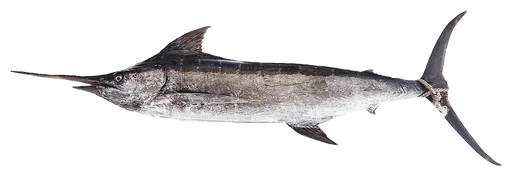
Photo: Hugues Evano (IFREMER, Délégation océan Indien (DOI), Département Ressources Biologiques et Environnement (RBE), F-97420 Le Port, France) · CC BY 4.0
Marlin
Makaira nigricansA tier · Elite17th of 51 sea creatures
Size & speed

- Weight
- 250 kg551 lb
- Length
- 3 m9.8 ft
As heavy as 3.6 people
Heavier than 83% of animals1.7× a person's height
Bigger than 85% of animalsA mature female blue marlin is a 250 kg open-ocean predator built around a long bill, powerful swimming and extraordinary migratory stamina. Its frontal weapon and three-dimensional mobility make it dangerous in open water, while modest armor and a directional attack geometry keep Defense below heavily protected marine animals.
Detailed ratings
Research-backed ratings on one 0–100 scale for all 344 animals (updated 2026-09-27). How ratings work


Card No. 49 of 344. Every animal on Animal Battle Stats has one: its power, tier and archetype on the front; its six battle stats, abilities and signature move on the back.
Special abilities
The elongated rigid upper jaw projects the damaging contact point ahead of the body, giving the marlin unusual frontal reach and concentrated strike geometry.
Physiology and locomotor design support persistent open-ocean movement across thousands of kilometers, making prolonged aquatic pursuit or disengagement unusually sustainable.
Unique traits
Females continue to attain much greater size and longevity than males, making the fighting-sex choice materially important to absolute combat scaling.
Diel depth use changes with light, temperature and oxygen in patterns consistent with visual predation and vertical prey tracking.
How it fights
Weapons
- The bill gives a blue marlin unusual frontal reach for a fish. In a hypothetical encounter the practical damage system is the rigid rostrum delivered by a large, fast, muscular body, backed by jaws once prey is close. The bill should not be modeled as an unrealistic sword: effectiveness depends on angle, relative motion, target anatomy and room to accelerate.
- Weight
- 250 kg551 lb
- Height
- No reliable measurement
- Length
- 3 m9.8 ft
- Top speed
- No reliable measurement
- Bite force
- No reliable measurement
- Lifespan
- 20 years
- Home biome
- Ocean
- Lifestyle
- Social
Rated specimen: Because females are the larger sex and therefore the stronger absolute combat specimen, ABS should use a healthy mature adult female.
Fun facts
- A radiocarbon-aged 565 kg female measured 371 cm lower-jaw fork length and was most likely close to 20 years old.
- NOAA reports females can reach more than 12 ft and roughly 2,000 lb, while males reach only about 7 ft.
- A global tag synthesis modeled median tracks of 2,678 km and a maximum track of 12,531 km.
- The old claim that billfish routinely swim around 35 m/s is inconsistent with modern biomechanical and tagging evidence.
- Blue marlin depth use changes with light, oxygen and sea-surface temperature, supporting a dynamic visual-hunting strategy.
Closest rivals by power. Tap one for the full breakdown, or pick any opponent.
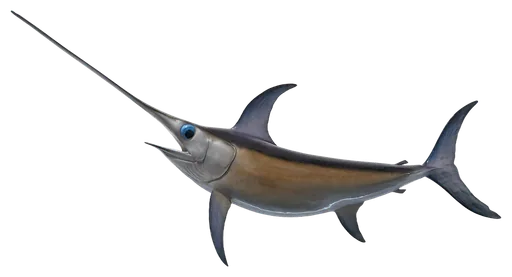
vs SealWins · 56% · Toss-up 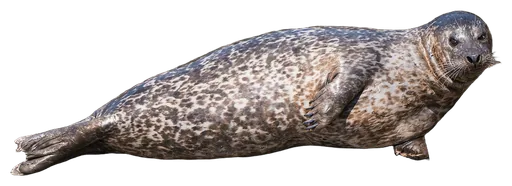 W vs SwordfishWins · 52% · Toss-up
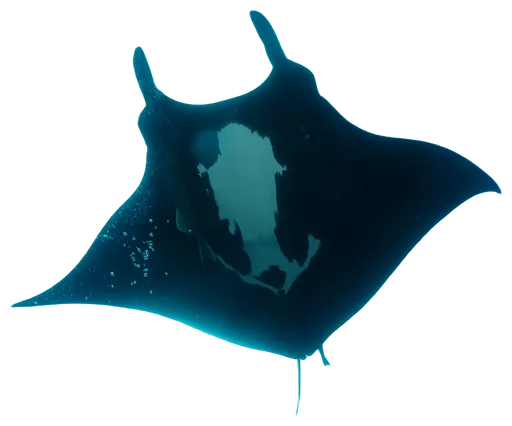
 W vs Manta RayLoses · 59% · Slight edge
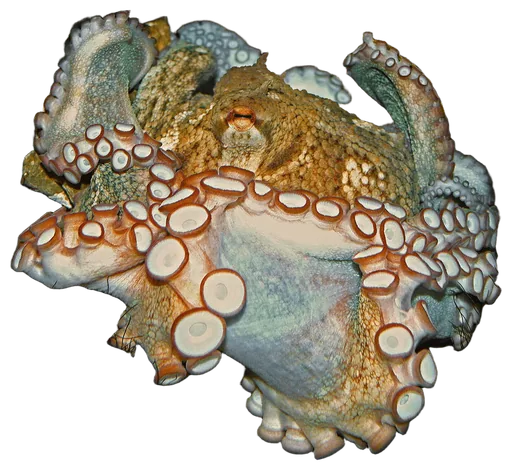
 L vs OctopusWins · 64% · Slight edge
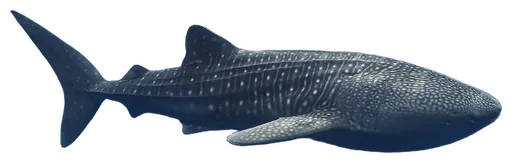
 W vs Whale SharkLoses · 70% · Clear edge
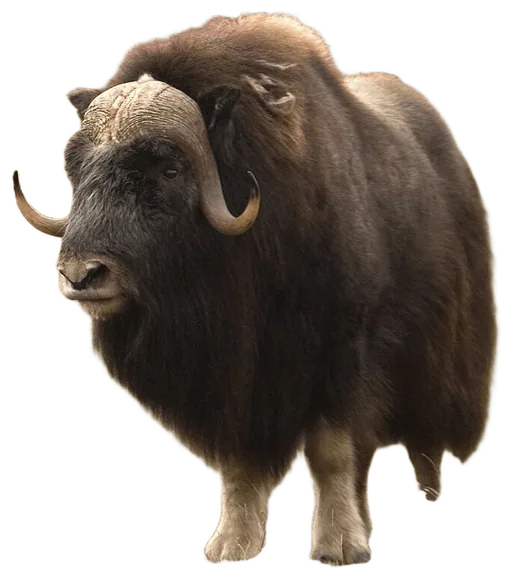
 L vs Musk OxLoses · 51% · Toss-up
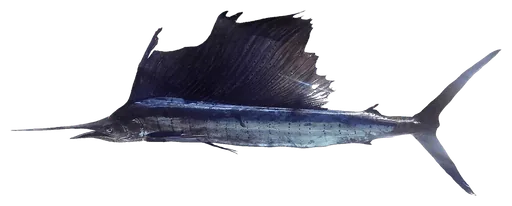
 L vs SailfishWins · 60% · Slight edge
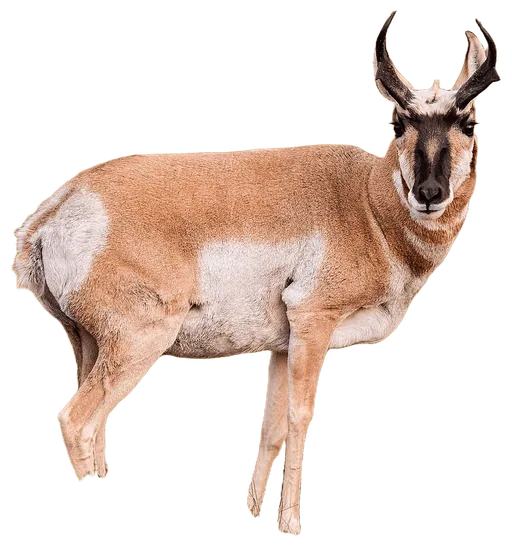
 W vs PronghornWins · 59% · Slight edge
 W
Marlin battle analysis
The blue marlin is not simply a “fast fish.” Its battle-relevant design is an integrated pelagic system: a streamlined body supplies sustained propulsion, a long rostrum places a hard contact point well ahead of the head, and visual hunting behavior lets the animal exploit a huge three-dimensional arena. A large female can outweigh a large male several times over, so sex matters enormously when choosing a canonical combat specimen.
The strongest evidence for the marlin is endurance rather than internet speed records. Satellite tags show movements spanning thousands of kilometers, while modern biomechanics casts serious doubt on historic claims of 30-plus-meter-per-second billfish. ABS therefore gives the marlin elite Stamina and strong Agility without turning an unsupported speed misconception into a factual field. Its weaknesses are equally clear: there is no heavy armor, its bill is most useful when the fish has space and alignment, and a close opponent that gets beside the rostrum removes much of that reach advantage.
Habitat & range
Blue marlin occur throughout tropical and subtropical Atlantic, Pacific and Indian Ocean waters. NOAA describes them as strongly pelagic, generally favoring warm, well-mixed surface water and spending much time in the upper water column. Tagging nevertheless shows substantial vertical and horizontal movement.
Diet & hunting
They are large open-ocean predators feeding mainly on tuna and other pelagic fishes, with cephalopods and other prey contributing regionally. Their ecological role is that of a mobile upper-level predator rather than a resident reef hunter.
Social life
Blue marlin are generally encountered as solitary pelagic predators rather than stable cooperative groups. NOAA places male maturity around two years and female maturity around three to four years, with spawning in warm-season waters. Rapid juvenile growth can produce 0.9–1.8 m fish within the first one to two years.
Conservation
Blue marlin are heavily interacted with by international pelagic fisheries and are iconic recreational game fish. NOAA manages U.S. Pacific fisheries with international coordination because migrations cross jurisdictions. Catch-and-release tagging has generated important movement and survival data.
Quick answers
How strong is a Marlin?
On the Animal Battle Stats scale, the Marlin has an attack rating of 58 and a power index of 62.9 out of 100, which ranks it #49 of 344 animals and puts it in A tier (Elite). Its strongest stat is stamina (90).
How much does a Marlin weigh?
A typical adult Marlin weighs about 250 kg (551 lb). Rated specimen: Because females are the larger sex and therefore the stronger absolute combat specimen, ABS should use a healthy mature adult female.
How fast is a Marlin?
There is no reliable measured top speed for the Marlin, so we do not publish one. Its agility rating, which covers acceleration, reflexes and evasion, is 78 out of 100.
What does a Marlin eat?
They are large open-ocean predators feeding mainly on tuna and other pelagic fishes, with cephalopods and other prey contributing regionally. Their ecological role is that of a mobile upper-level predator rather than a resident reef hunter.
What animals can beat a Marlin?
Among its closest rivals, the Manta Ray (59%), the Whale Shark (70%), the Musk Ox (51%) would be favored against the Marlin. It would be favored against the Seal, the Swordfish, the Octopus, the Sailfish, the Pronghorn.
Researched 2026-09-27. Ratings are editorial judgments built from these sources; measurements describe a healthy adult female.
- NOAA Fisheries, Pacific Blue Marlintaxonomy, dimorphism, size, lifespan, diet, habitat, maturity
- Andrews et al. 2018 / NOAA repositorylongevity, exceptional female measurement
- 2025 ICES growth analysis / NOAA repositorysex dimorphism, growth, age ranges
- Dale et al. 2022 / NOAA repositorymigration/endurance
- Kraus et al. 2023 / NOAA repositorydiel/seasonal habitat, visual hunting
- Svendsen et al. 2016, Biology Openspeed misconception calibration
- Commons NOAA imageimage candidate
- Commons IFREMER imagealternate image candidate
Photo: “Marlin bleu (Makaira nigricans) (Ifremer 00761-87302).jpg” by Hugues Evano (IFREMER, Délégation océan Indien (DOI), Département Ressources Biologiques et Environnement (RBE), F-97420 Le Port, France), CC BY 4.0, background removed and cropped. Original
Suggest a correction