
Manta Ray
Mobula birostrisA tier · Elite20th of 51 sea creatures
Size & speed

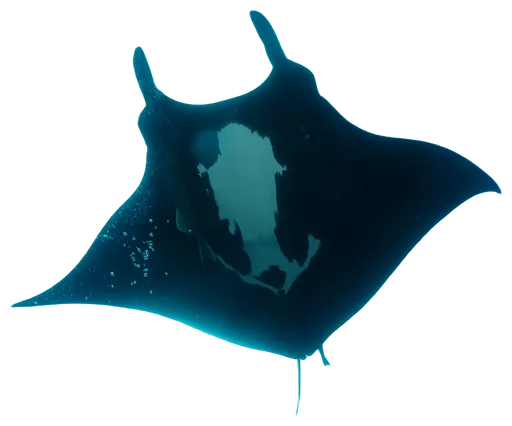
- Weight
- 1.4 t1.5 US tons
- Length
- 5 m16.4 ft
As heavy as 20 people
Heavier than 95% of animals2.9× a person's height
Bigger than 94% of animalsThe giant oceanic manta ray is the world's largest living ray: a multi-ton-capable, wing-driven pelagic filter feeder built for efficient travel, deep diving and remarkable control in open water. Its sheer size and stamina make it difficult for small opponents to threaten, but unlike sharks or toothed whales it has almost no specialized offensive weaponry. Its battle profile is therefore defined by mass, endurance and aquatic maneuverability rather than lethal attack.
Detailed ratings
Research-backed ratings on one 0–100 scale for all 344 animals (updated 2026-09-27). How ratings work


Card No. 55 of 344. Every animal on Animal Battle Stats has one: its power, tier and archetype on the front; its six battle stats, abilities and signature move on the back.
Special abilities
The giant pectoral disc generates efficient lift and thrust for sustained three-dimensional swimming, rapid banking, looping, depth changes and occasional breaching. In a matchup this provides unusually strong positional control for a tonne-scale fish.
Paired cephalic lobes unfurl to channel prey-rich water into the terminal mouth and specialized branchial filter. This is a genuine anatomical system and can manipulate water/prey flow, but it is correctly treated as a low-damage specialization rather than a fictional suction weapon.
Unique traits
M. birostris is the largest living ray, with NOAA reporting disc widths up to 26 ft and mass up to 5,300 lb.
Mobulids possess unusually large, metabolically expensive brains; recent work proposes that this neural mass may also contribute to cranial thermogenesis during cold-water exposure, a hypothesis that cautions against equating brain size directly with intelligence.
How it fights
Weapons
- The giant manta has no purpose-built killing weapon. Its most consequential offensive asset is simply the momentum of a 1.4-tonne, 5 m-wide swimming body. Pectoral-fin sweeps, body checks and collision momentum could seriously affect much smaller animals, but there is no evidence that healthy giant mantas routinely weaponize ramming against predators. The mouth is a secondary gripping structure during mating rather than a slicing or crushing predatory bite.
Struggles vs
- Almost no specialized offensive weaponry for its body size.
- No venomous sting or defensive barb.
- Broad pectoral margins can be bitten or amputated by large predators.
- Planktivorous behavior provides little practical experience killing large prey.
- Very large span reduces close-quarters maneuverability in confined water.
- Weight
- 1.4 t1.5 US tons
- Height
- No reliable measurement
- Length
- 5 m16.4 ft
- Top speed
- No reliable measurement
- Bite force
- No reliable measurement
- Lifespan
- 45 years
- Home biome
- Ocean
- Lifestyle
- Social
Rated specimen: Healthy, sexually mature adult female, approximately 1,400.0 kg and 500.0 cm disc width.
Fun facts
- Giant oceanic mantas are the largest living rays.
- They can breach completely out of the water despite tonne-scale body mass.
- A satellite-tagged manta in Japan reached 1,082 m depth.
- Manta courtship can involve long pursuit trains in which several males follow one female.
- Their cephalic lobes are rolled while cruising and unfurled to help funnel food during feeding.
- Individual body markings can function like natural identification cards for photo-ID research.
Closest rivals by power. Tap one for the full breakdown, or pick any opponent.
vs SwordfishWins · 61% · Slight edge 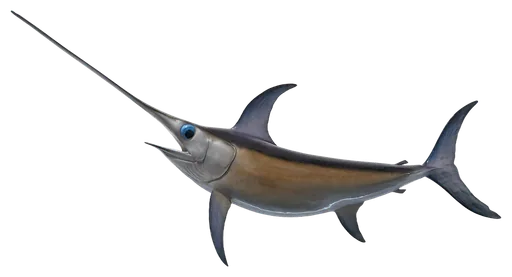 W vs SealWins · 64% · Slight edge
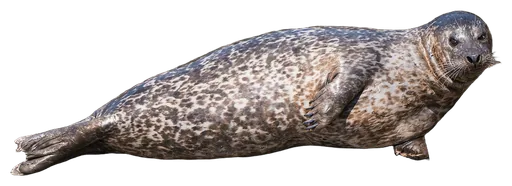 W vs OctopusWins · 72% · Clear edge
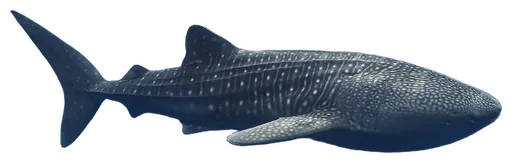
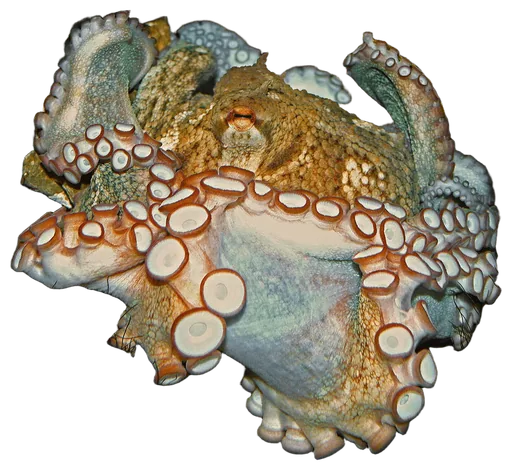 W vs Whale SharkLoses · 62% · Slight edge
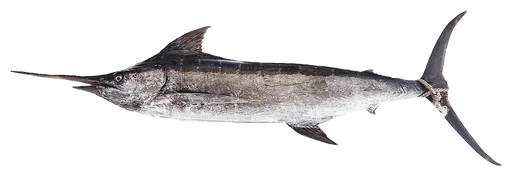
 L vs MarlinWins · 59% · Slight edge
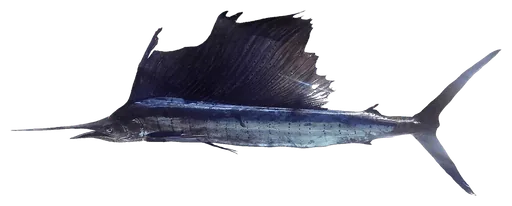
 W vs SailfishWins · 68% · Slight edge
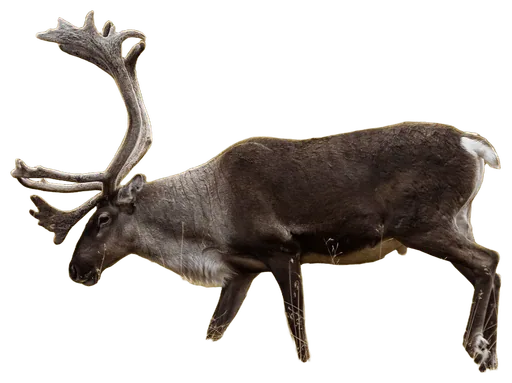
 W vs ReindeerWins · 62% · Slight edge
 W vs GorillaWins · 62% · Slight edge
 W
Manta Ray battle analysis
A giant oceanic manta looks like a combat heavyweight, but its biology tells a subtler story. A mature female can span roughly five metres from wingtip to wingtip and weigh well over a tonne, yet nearly every part of that enormous body is optimized for travelling and feeding rather than killing. Its pectoral fins beat through the water like wings, producing enough lift and thrust to carry the ray across hundreds of kilometres, through rapid banks and loops, and down into water more than a kilometre deep. The mouth is a plankton intake. The cephalic lobes are flow-control surfaces. The tail lacks the venomous sting many people expect from a ray.
That makes M. birostris an important ABS calibration animal. Raw body size cannot automatically become Attack. Against a small opponent, the manta's mass and momentum are overwhelming, and its broad disc is difficult to grapple or displace. Against a large shark, however, the mismatch in weaponry becomes obvious. Sharks can remove pieces of the exposed pectoral margin, and killer whales can overpower large rays. The manta survives by being large, mobile, perceptive and difficult to catch cleanly, not by trading bites.
Its most impressive qualities are endurance and behavioral complexity. Telemetry now confirms repeated long-distance travel and dives beyond 1,000 m. Mantas also use cleaning stations, aggregate predictably, perform elaborate courtship pursuits and respond to mirrors in ways that have generated serious scientific debate about cognition. The evidence supports a highly capable fish, but not exaggerated claims of proven human-like self-awareness. In ABS terms, the giant manta is a defensive pelagic endurance specialist whose spectacular size masks a surprisingly modest offensive arsenal.
Habitat & range
The giant oceanic manta occurs circumglobally in tropical, subtropical and temperate seas. NOAA describes it in offshore oceanic water, productive coastal zones, bays, inlets and occasionally estuarine environments. It uses reefs, islands, seamounts and productivity fronts as feeding, cleaning or aggregation areas and can descend beyond 1,000 m.
Diet & hunting
Diet is dominated by zooplankton and other small planktonic organisms captured through ram filtration. The animal is a highly mobile consumer linking pelagic productivity hotspots. Aggregations form where prey concentrates and at cleaning stations, but individuals also spend substantial time alone or in small groups.
Social life
Mobulids can aggregate from a few individuals to large groups, especially where food or cleaning opportunities are concentrated. Courtship includes prolonged pursuit and mating trains. Photo-identification based on individual markings has revealed repeated site use and regional movement. Social complexity is real, but the evidence does not justify assuming mammal-like cooperative combat.
Conservation
The giant manta ray is Endangered on the IUCN Red List and listed as Threatened under the U.S. Endangered Species Act. Major threats include targeted harvest, bycatch, demand for gill plates, entanglement, vessel strikes and other anthropogenic impacts.
Quick answers
How strong is a Manta Ray?
On the Animal Battle Stats scale, the Manta Ray has an attack rating of 42 and a power index of 62.3 out of 100, which ranks it #55 of 344 animals and puts it in A tier (Elite). Its strongest stat is stamina (89).
How much does a Manta Ray weigh?
A typical adult Manta Ray weighs about 1.4 t (1.5 US tons). Rated specimen: Healthy, sexually mature adult female, approximately 1,400.0 kg and 500.0 cm disc width.
How fast is a Manta Ray?
There is no reliable measured top speed for the Manta Ray, so we do not publish one. Its agility rating, which covers acceleration, reflexes and evasion, is 72 out of 100.
What does a Manta Ray eat?
Diet is dominated by zooplankton and other small planktonic organisms captured through ram filtration. The animal is a highly mobile consumer linking pelagic productivity hotspots. Aggregations form where prey concentrates and at cleaning stations, but individuals also spend substantial time alone or in small groups.
Is the Manta Ray endangered?
The Manta Ray's conservation status is Endangered. The giant manta ray is Endangered on the IUCN Red List and listed as Threatened under the U.S. Endangered Species Act. Major threats include targeted harvest, bycatch, demand for gill plates, entanglement, vessel strikes and other anthropogenic impacts.
What animals can beat a Manta Ray?
Among its closest rivals, the Whale Shark (62%) would be favored against the Manta Ray. It would be favored against the Swordfish, the Seal, the Octopus, the Marlin, the Sailfish, the Reindeer, the Gorilla.
Researched 2026-09-27. Ratings are editorial judgments built from these sources; measurements describe a healthy adult female.
- NOAA Fisheries, Giant Manta RayTaxonomy, maximum size, longevity, range, reproduction, threats
- NOAA ESA Recovery Status Review (2024)Longevity, dimorphism, life history
- Manta Trust, Mobula birostris guideRepresentative/max disc width, mass, ID
- Florida Museum, Manta RayMass, maturity, diet, predators
- Ozaki et al., Journal of Fish Biology (2026)Movement, endurance, depth
- Couturier et al. 2012, Journal of Fish BiologyMobulid ecology, feeding, aggregation, movement
- Arostegui 2025, Journal of Animal EcologyBrain physiology
- Ari & D'Agostino 2016, Journal of Ethology recordCognition
- Stewart et al. 2016 response, Manta Trust portalCognition conflict
- Diversity 2024 courtship observationCourtship mechanics
- Frontiers in Marine Science 2022Injury, toughness, vulnerability
- Commons / iNaturalist candidateImage taxon, dimensions, license
Photo: “Manta melanistic.jpg” by Stevelaycock21, CC BY-SA 4.0, background removed and cropped. Original
Suggest a correction