
Harpy Eagle
Harpia harpyjaB tier · Strong10th of 55 birds
Size & speed

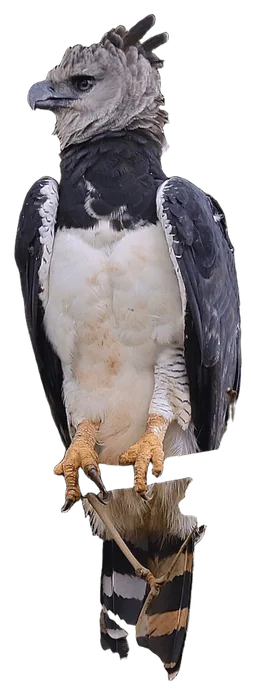
- Weight
- 8 kg18 lb
- Length
- 1 m3.3 ft
As heavy as 1.8 house cats
Heavier than 44% of animalsAbout 3.3 rulers long
Bigger than 44% of animalsThe Harpy Eagle is an 8 kg female-biased canopy ambush specialist whose oversized feet and talons let it seize monkeys, sloths and other substantial arboreal prey. Its short broad wings, long tail, acute vision and acoustic targeting make it exceptionally maneuverable in rainforest, but low absolute body mass and minimal armor keep its raw power and defense far below large mammalian predators.
Detailed ratings
Research-backed ratings on one 0–100 scale for all 344 animals (updated 2026-09-27). How ratings work


Card No. 147 of 344. Every animal on Animal Battle Stats has one: its power, tier and archetype on the front; its six battle stats, abilities and signature move on the back.
Special abilities
A rapid perch-launched attack that combines forest maneuvering with massive feet and long talons to seize and puncture arboreal prey before it can establish a stable escape route.
A retractable facial-disc system combined with acute vision improves localization of partly hidden canopy prey, strengthening target acquisition in visually cluttered forest.
Unique traits
Females are substantially heavier than males, making the mature female the appropriate canonical combat sex and enabling capture of larger prey.
Broad, comparatively short wings and a long tail trade open-air speed specialization for exceptional control between trunks and branches.
How it fights
Weapons
- The feet and talons are the decisive weapons. The rear talon can approach 12.5–13 cm at the upper end, and the bird's feet are unusually massive for an eagle. The bill is secondary and most useful after the feet establish control.
- Weight
- 8 kg18 lb
- Height
- 90 cm35.4 in
- Length
- 1 m3.3 ft
- Top speed
- No reliable measurement
- Bite force
- No reliable measurement
- Lifespan
- 30 years
- Home biome
- Jungle
- Lifestyle
- Mostly solitary
Rated specimen: Healthy mature female, 8.0 kg, approximately 100.0 cm body length and 200.0 cm wingspan.
Fun facts
- The harpy eagle's rear talons can reach roughly 12.5–13 cm at the upper end.
- Females are substantially heavier than males and can approach 9 kg in normal published ranges.
- Central-Amazon breeding pairs in one study ate primarily sloths by both prey count and biomass.
- A classic nest study found the female performed 97% of incubation.
- Pairs typically raise only one young and may breed only once every 2–3 years.
- Harpy eagles can remain perched for extremely long periods while watching and listening for canopy prey.
Closest rivals by power. Tap one for the full breakdown, or pick any opponent.
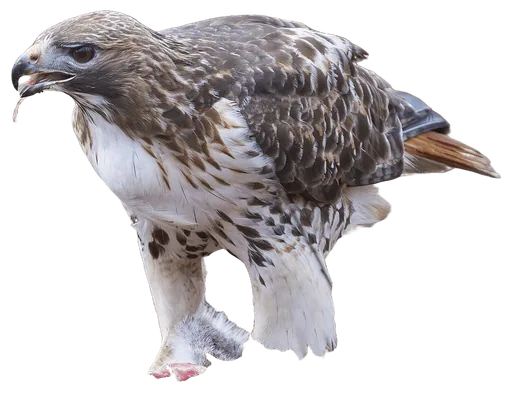
vs Wedge-tailed EagleWins · 54% · Toss-up 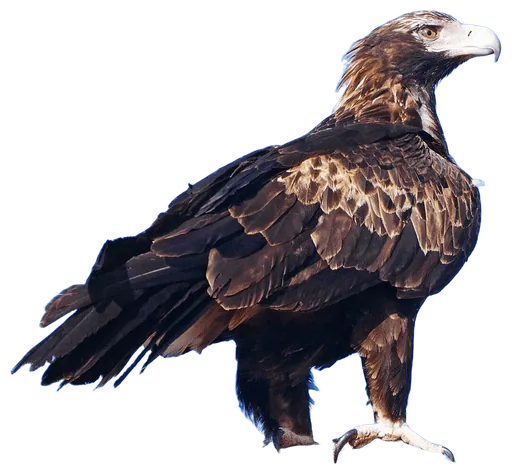 W vs Red-tailed HawkWins · 61% · Slight edge
 W vs Emperor PenguinLoses · 59% · Slight edge
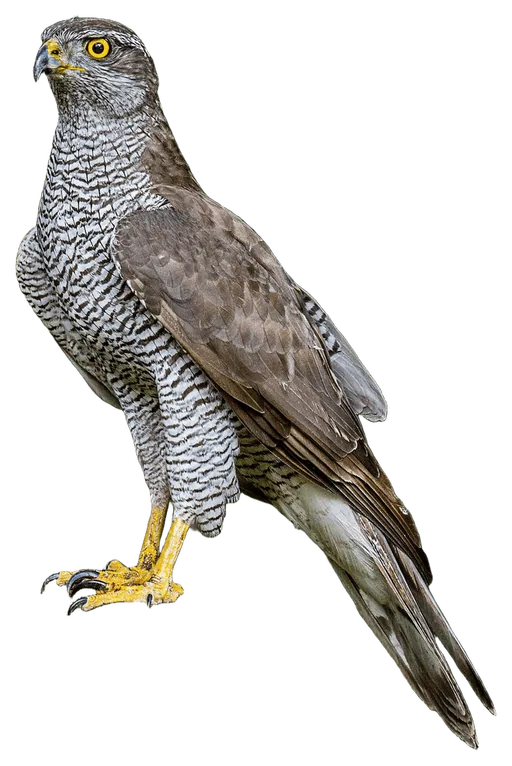
 L vs Northern GoshawkWins · 61% · Slight edge
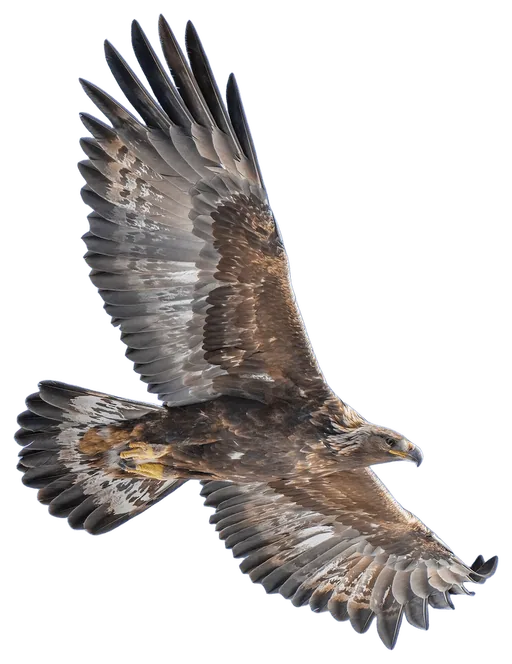
 W vs Golden EagleWins · 52% · Toss-up
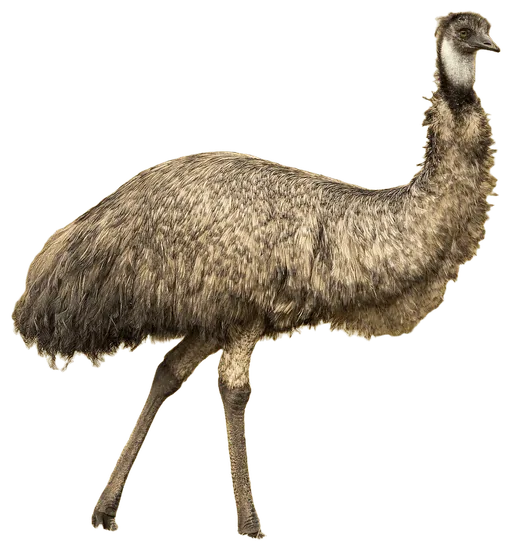
 W vs EmuLoses · 60% · Slight edge
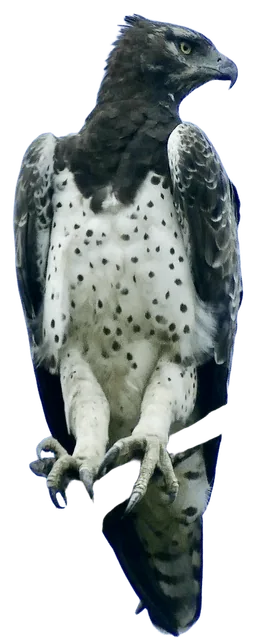
 L vs Martial EagleWins · 51% · Toss-up
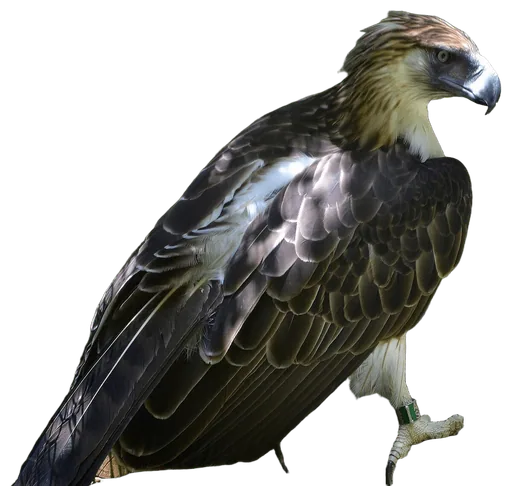
 W vs Philippine EagleWins · 53% · Toss-up
 W
Harpy Eagle battle analysis
The Harpy Eagle is dangerous because its anatomy is concentrated around one job: finding a concealed animal in a dense canopy, reaching it through a maze of branches, and establishing lethal control with the feet. It does not need the body mass of a wolf or big cat to be a formidable aerial attacker. Long curved talons, thick legs, broad wings and a long steering tail make the bird unusually capable of delivering precise force from a three-dimensional approach.
That specialization also defines its limits. An 8 kg eagle is still an 8 kg animal on an absolute roster. Its feet can control prey astonishingly large relative to itself, but that feat must not be converted into gorilla-like Raw Power or mammalian durability. Once grounded, pinned, or deprived of flight space, its defense falls sharply. Its strongest matchups are those in which it controls when and where contact happens.
The species' ecology reinforces that interpretation. Harpy eagles spend long periods perched, using acute sight and hearing to locate arboreal mammals, then attack in short decisive episodes. Their forest dependence is so strong that heavy deforestation reduces prey delivery and can make reproduction nonviable. The same morphology that makes them superb canopy predators is not a universal combat advantage in every environment.
Habitat & range
Harpy eagles inhabit tropical forests of the Neotropics from southern Mexico through Central America and across much of northern and central South America. Remaining strongholds are concentrated in large forest landscapes, especially Amazonia. They depend strongly on mature forest structure and large nesting trees.
Diet & hunting
The species is a top canopy predator. Sloths and monkeys are major prey, supplemented by other arboreal mammals, reptiles and birds. Central-Amazon research documented 14 prey species across five breeding pairs, while range-wide literature records many more. The eagle's ecological role is therefore specialized around canopy vertebrates but not a single prey species.
Social life
Adults are generally encountered singly or as monogamous pairs. Hunting is solitary. Pair bonds and prolonged parental investment dominate social organization rather than packs or flocks.
Conservation
The species is threatened by forest loss, fragmentation and shooting. A 2021 study of 16 active nests found prey delivery and reproductive viability deteriorated strongly with forest loss; no nests were supported in landscapes above 70% forest loss, and landscapes above 50% loss could not reliably provision young to independence. Recent Atlantic Forest work continues to document shooting, electrocution and road mortality.
Quick answers
How strong is a Harpy Eagle?
On the Animal Battle Stats scale, the Harpy Eagle has an attack rating of 44 and a power index of 52.5 out of 100, which ranks it #147 of 344 animals and puts it in B tier (Strong). Its strongest stat is agility (91).
How much does a Harpy Eagle weigh?
A typical adult Harpy Eagle weighs about 8 kg (18 lb). Rated specimen: healthy mature female, 8.0 kg, approximately 100.0 cm body length and 200.0 cm wingspan.
How fast is a Harpy Eagle?
There is no reliable measured top speed for the Harpy Eagle, so we do not publish one. Its agility rating, which covers acceleration, reflexes and evasion, is 91 out of 100.
What does a Harpy Eagle eat?
The species is a top canopy predator. Sloths and monkeys are major prey, supplemented by other arboreal mammals, reptiles and birds. Central-Amazon research documented 14 prey species across five breeding pairs, while range-wide literature records many more. The eagle's ecological role is therefore specialized around canopy vertebrates but not a single prey species.
What animals can beat a Harpy Eagle?
Among its closest rivals, the Emperor Penguin (59%), the Emu (60%) would be favored against the Harpy Eagle. It would be favored against the Wedge-tailed Eagle, the Red-tailed Hawk, the Northern Goshawk, the Golden Eagle, the Martial Eagle, the Philippine Eagle.
Researched 2026-09-27. Ratings are editorial judgments built from these sources; measurements describe a healthy adult female.
- Animal Diversity Web, Harpia harpyjamorphology, lifespan, behavior, reproduction
- Miranda 2018, Tropical Conservation Sciencesex-specific mass, prey ecology
- Aguiar-Silva et al. 2014, Journal of Raptor Researchdiet and predation
- Kaizer et al. 2023, Scientific Reportsprey mass, sensory ecology, Atlantic Forest diet
- Rettig 1978, The Aukbreeding behavior
- USGS, Alvarez & Ellis 1994nesting interval, human threats
- Miranda et al. 2021, PubMeddeforestation and reproductive viability
- Guinness World Records, longest eagle talonsmaximum talon length
- The Peregrine Fundthreats, dimorphism, natural history
- Commons, Luiz Fernando Matosimage candidate
Photo: “Gavião-real (Harpia harpyja).jpg” by Luiz Fernando Matos, CC BY-SA 4.0, background removed and cropped. Original
Suggest a correction