
Coconut Crab
Birgus latroC tier · Capable4th of 30 bugs & spiders
Size & speed

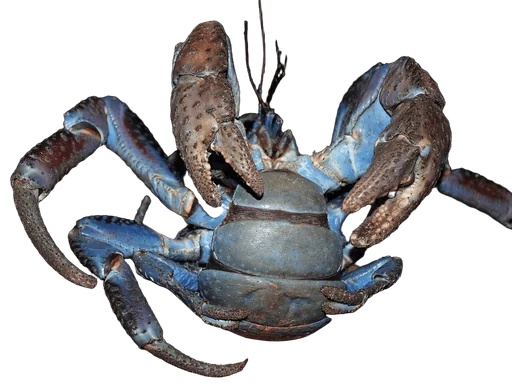
- Weight
- 3 kg7 lb
- Length
- 40 cm15.7 in
About as heavy as a house cat
Heavier than 31% of animalsAbout 1.3 rulers long
Bigger than 20% of animalsThe coconut crab is the world's largest terrestrial arthropod, a slow but heavily built island scavenger armed with one of the most powerful claws measured in a land invertebrate. A large male combines a hardened exoskeleton, strong climbing ability and extraordinary aerial smell with a kilonewton-class grip capable of subduing surprisingly large prey. Its weaknesses are equally clear: low absolute mass, poor speed, vulnerable joints and a respiratory system specialized for land rather than prolonged submersion.
Detailed ratings
Research-backed ratings on one 0–100 scale for all 344 animals (updated 2026-09-27). How ratings work


Card No. 253 of 344. Every animal on Animal Battle Stats has one: its power, tier and archetype on the front; its six battle stats, abilities and signature move on the back.
Special abilities
The oversized chela produces directly measured pinch forces up to 1,765.2 N in the sampled wild crabs, with the published body-mass relationship predicting roughly 3,300 N at the 4 kg species upper end. A secured grip can crush, hold and disable surprisingly large targets.
An unusually enlarged central olfactory pathway supports powerful aerial odor tracking, allowing the crab to locate food and carrion effectively in nocturnal island habitat.
Unique traits
Unlike its own juvenile stage and the terrestrial hermit crabs it is grouped with, the adult hardens its abdomen and abandons borrowed shells, becoming the largest living terrestrial arthropod.
Highly modified branchiostegal respiratory surfaces support a fully terrestrial adult existence, a rare trait among crustaceans that also makes prolonged underwater exposure a liability.
How it fights
Weapons
- The dominant weapon is the oversized chela, especially the larger left claw. Unlike many tiny arthropod feats that disappear on an absolute scale, coconut-crab pinch force remains impressive even in absolute terms for a 3-4 kg animal. Direct measurements reached 1.77 kN, while the body-mass regression predicts 3.3 kN at the largest reported 4 kg size. The claw can grip, crush and hold, and the force rises steeply with body size.
- The key limitation is delivery. The crab is slow compared with mammalian and avian predators, lacks long striking reach, and must get a claw onto a vulnerable structure. Once a firm grip is achieved, however, the opponent faces a mechanically serious clamp that is difficult to dismiss as merely proportional strength.
Struggles vs
- Low absolute body mass compared with serious vertebrate combatants.
- Slow attack delivery and pursuit speed.
- Joints and membranes remain vulnerable despite the exoskeleton.
- No venom, ranged weapon or rapid strike system.
- Molting creates a prolonged vulnerable phase.
- Weight
- 3 kg7 lb
- Height
- No reliable measurement
- Length
- 40 cm15.7 in
- Top speed
- No reliable measurement
- Bite force
- No reliable measurement
- Lifespan
- 50 years
- Home biome
- Jungle
- Lifestyle
- Social
Rated specimen: Healthy, fully mature adult male, 3.0 kg, representing a large but non-record male.
Fun facts
- The largest published pinch-force study directly measured 1,765.2 N in its wild sample and predicted about 3,300 N for a 4 kg crab.
- Coconut crabs are the largest living terrestrial arthropods.
- Adults abandon the borrowed shells used during their juvenile hermit-crab phase because the abdomen becomes hardened and protective.
- Their brains devote extraordinary neural resources to smell, with roughly one million interneurons associated with processing olfactory input reported in the neuroanatomical study.
- A published field observation documented a coconut crab killing an adult red-footed booby, proving that the claw can be used against vertebrate prey.
- Females must approach the sea to release larvae even though the adult animal is specialized for life on land.
Closest rivals by power. Tap one for the full breakdown, or pick any opponent.
vs DragonflyWins · 87% · Decisive  W vs Monarch ButterflyWins · 89% · Decisive
 W vs NautilusWins · 62% · Slight edge
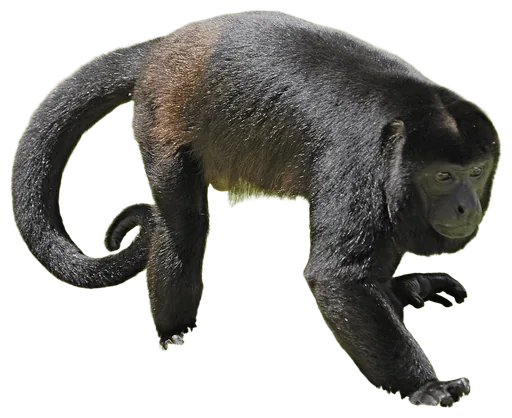
 W vs Howler MonkeyLoses · 55% · Toss-up
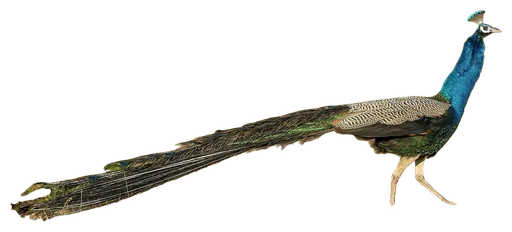
 L vs PeacockLoses · 53% · Toss-up
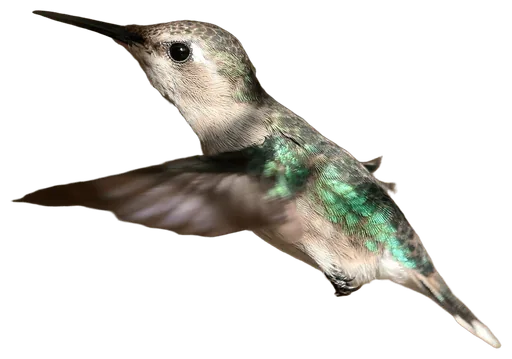
 L vs HummingbirdWins · 83% · Clear edge
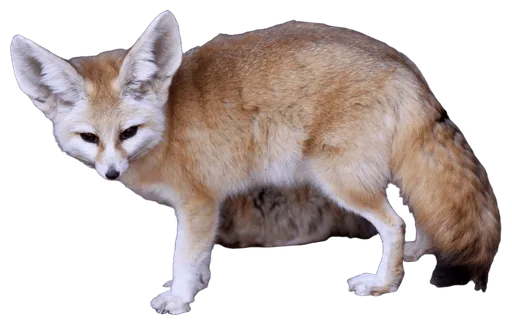
 W vs Fennec FoxWins · 54% · Toss-up
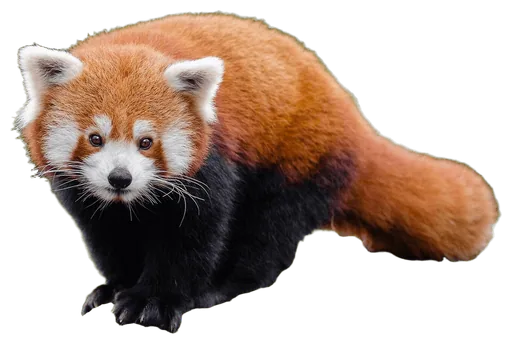
 W vs Red PandaLoses · 53% · Toss-up
 L
Coconut Crab battle analysis
The coconut crab is a useful test of ABS's absolute-scaling rules because it combines a tiny overall body compared with major vertebrates and one mechanically extraordinary weapon. Calling it merely 'strong for its size' understates the claw: the best experiment directly measured forces well above a kilonewton, and the authors' allometric model reaches 3.3 kN at the 4 kg upper end. That is enough to make contact dangerous even for animals much larger than the crab.
But the weapon must be delivered. A coconut crab does not sprint down prey like a cat, strike at range like a snake, or launch aerial attacks like a raptor. It walks, climbs, follows odor and exploits close opportunities. Its ideal fight is one where terrain, concealment or an opponent's mistake lets the large chela secure a limb or other vulnerable structure. Once clamped, the crab can brace with multiple legs and turn an otherwise slow encounter into a crushing mechanical contest.
The adult exoskeleton gives it real protection against small opponents, while the unusual land-breathing system and powerful aerial olfaction make it exceptionally competent in humid island forest. These traits deserve a high Special score. They do not justify heavyweight Attack or Defense. A 3 kg arthropod remains physically outclassed by wolves, big cats, great apes, large ungulates and megafauna, no matter how impressive its proportional engineering.
Habitat & range
Coconut crabs inhabit tropical islands across the Indian and Pacific Oceans, especially coastal forest, rocky terrain, limestone crevices and vegetated island interiors. Distribution is naturally fragmented by ocean barriers, and local abundance can differ dramatically between remote protected islands and heavily harvested inhabited islands.
Diet & hunting
Omnivorous and opportunistic. Important foods include fallen fruit, nuts, seeds, coconut material, carrion and animal prey. They also consume other crustaceans and can exploit hard foods inaccessible to weaker scavengers. The famous coconut association is real, but coconut is not the entire diet.
Social life
Primarily solitary. Agonistic encounters around food are strongly size-dependent, with larger individuals usually dominating. Visual displays and spacing reduce unnecessary escalation. Home ranges reported by ADW vary roughly from 40 to 250 m² depending on island context.
Conservation
The current global assessment is Vulnerable, replacing the older Data Deficient treatment still repeated by some legacy sources. Major concerns include harvest for food, slow growth, late maturity, habitat degradation and local population depletion. Conservation status should be rechecked against the current IUCN entry at production migration time.
Quick answers
How strong is a Coconut Crab?
On the Animal Battle Stats scale, the Coconut Crab has an attack rating of 39 and a power index of 42.9 out of 100, which ranks it #253 of 344 animals and puts it in C tier (Capable). Its strongest stat is special (78).
How much does a Coconut Crab weigh?
A typical adult Coconut Crab weighs about 3 kg (7 lb). Rated specimen: healthy, fully mature adult male, 3.0 kg, representing a large but non-record male.
How fast is a Coconut Crab?
There is no reliable measured top speed for the Coconut Crab, so we do not publish one. Its agility rating, which covers acceleration, reflexes and evasion, is 45 out of 100.
What does a Coconut Crab eat?
Omnivorous and opportunistic. Important foods include fallen fruit, nuts, seeds, coconut material, carrion and animal prey. They also consume other crustaceans and can exploit hard foods inaccessible to weaker scavengers. The famous coconut association is real, but coconut is not the entire diet.
Is the Coconut Crab endangered?
The Coconut Crab's conservation status is Vulnerable. The current global assessment is Vulnerable, replacing the older Data Deficient treatment still repeated by some legacy sources. Major concerns include harvest for food, slow growth, late maturity, habitat degradation and local population depletion. Conservation status should be rechecked against the current IUCN entry at production migration time.
What animals can beat a Coconut Crab?
Among its closest rivals, the Howler Monkey (55%), the Peacock (53%), the Red Panda (53%) would be favored against the Coconut Crab. It would be favored against the Dragonfly, the Monarch Butterfly, the Nautilus, the Hummingbird, the Fennec Fox.
Researched 2026-09-27. Ratings are editorial judgments built from these sources; measurements describe a healthy adult male.
- Oka, Tomita & Miyamoto, PLOS ONE (2016), A Mighty Clawclaw force, mass scaling, weapon function
- Frontiers in Zoology, Krieger et al. (2010)olfaction, neuroanatomy, senses
- Helfman (1977), agonistic behaviorfighting, dominance, social behavior
- Laidre (2017), Frontiers in Ecology and Environmentpredation
- Henry (1991), Journal of Experimental Zoologyterrestrial respiration
- Anagnostou & Schubart morphometricsdimorphism, heterochely
- Drew & Hansson population structuresexual dimorphism
- Animal Diversity Webbehavior, lifespan, reproduction, ecology
- Australian Geographic fact fileupper size, sex difference, lifespan
- Hamasaki et al. (2016), Aquaculture Researchlarval development / conservation context
- Reproductive migration studymigration/reproduction
- GBIF taxontaxonomy
- Wikimedia Commons, Lance Vanlewenimage provenance
- USGS coconut crab mediaalternate image provenance
Photo: “Kepiting kenari, yg hidup di darat bebatuan. adanya di simpu, yg populasinya uda mulai punah. - panoramio.jpg” by Dani Albakia, CC BY-SA 3.0, background removed and cropped. Original
Suggest a correction