

Brazilian Wandering Spider
Phoneutria nigriventer
 #232 of 273
  Jungle Venomous Hunter Not Evaluated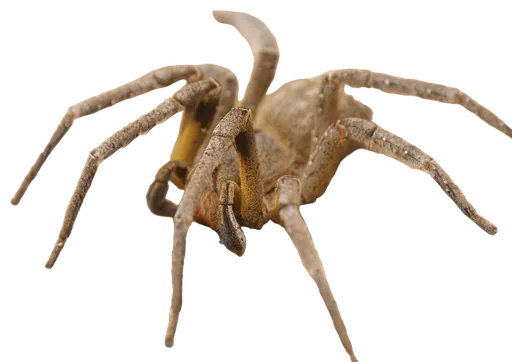
 Fight
FightPhoto: Rodrigo Tetsuo Argenton · CC BY-SA 4.0
A fast, webless night hunter from Brazil's forests, the Brazilian wandering spider backs its dramatic rearing threat display with one of the most medically significant spider venoms. The venom is a multi-toxin nerve cocktail, but a 4 g body, a small per-bite dose and a soft exoskeleton keep its absolute Attack and Defense low on the full roster.
 Attack27
  Defense5
  Agility72
  Stamina36
  Intelligence34
  Special93
 Detailed ratings
Research-backed ratings on one 0–100 scale for all 273 animals (updated 2026-09-28). How ratings work
Special abilities
Ability 1Armadeira Threat StanceThe spider rears up, raises its front two leg pairs to flash the banded undersides and sways while keeping its fangs forward. The display often ends an encounter without contact, and if it does not, the spider is already in striking position.
 Ability 2Multi-Channel Neurotoxin
The venom mixes toxin fractions that hit calcium and sodium channels and nitric-oxide pathways (PhTx3, Tx2-5, Tx2-6). One bite can cause intense pain and, in rare severe cases, cardiovascular and respiratory effects.
Unique traits
 TraitWebless Night Roamer
Instead of waiting in a web, it hunts by walking the forest floor and foliage at night and hides in crevices, leaves or buildings by day. That habit also brings it into houses and cargo.
TraitFemale-Weighted ArsenalAdult females yield about three times more venom than equal-sized males, and their venom is more lethal in laboratory tests. The larger sex also carries the stronger weapon.
How it fights
Weapons
- The main weapon is a pair of fangs delivering a complex neurotoxic venom. P. nigriventer venom contains several toxin fractions (PhTx1–PhTx4) with different targets. PhTx3 is a broad-spectrum calcium-channel blocker that inhibits glutamate release, and the Tx2 fraction includes Tx2-5 and Tx2-6, which cause priapism through a nitric-oxide pathway and can kill mice. PhTx1, PhTx2 and PhTx3 all act on mammals. This multi-target cocktail is the reason the spider is medically important and why it rates highly in Special.
 Beats
Beats
- Insects, other spiders and small frogs or lizards within its prey range.
- Small, thin-skinned animals that must engage at close range.
 Struggles vs
- Any mammal, bird or reptile large enough to crush it before venom acts.
- Armoured arthropods and animals with protective hair, scales or shells that block fang penetration.
- Fast aerial predators that strike from above.
- Weight
- 4 g0.1 oz
- Height
- No reliable measurement
- Length
- 3.5 cm1.4 in
- Top speed
- No reliable measurement
- Bite force
- No reliable measurement
- Lifespan
- 2 years
- Home biome
- Jungle
- Lifestyle
- Mostly solitary, nocturnal
Rated specimen: Healthy mature adult female, 3.5 cm body length (prosoma plus opisthosoma), roughly 13–15 cm leg span, estimated about 4 g live mass.
Fun facts
- The genus name Phoneutria comes from Greek for "murderess".
- In one Brazilian case series, 89.8% of bites were mild and only 0.5% were severe.
- Adult females produce nearly three times the venom of equal-sized males.
- The toxin Tx2-6 causes priapism in laboratory mice, which is why the species turns up in toxin-mechanism research.
- Over half the bites in one clinical study happened indoors, usually when a hiding spider was disturbed.
- A venom peptide, Phα1β, is being tested as a painkiller.
Closest rivals by power. Tap one for the full breakdown, or pick any opponent.
vs Giant CentipedeLoses · 50% · Toss-up  L vs Praying MantisWins · 51% · Toss-up
  W vs King CrabLoses · 52% · Toss-up
  L vs HedgehogLoses · 50% · Toss-up
  L vs QuokkaLoses · 50% · Toss-up
  L vs TapirLoses · 51% · Toss-up
  L vs KookaburraLoses · 51% · Toss-up
  L vs AlpacaWins · 51% · Toss-up
  W
W  Pick any opponent
 Brazilian Wandering Spider battle analysis
The Brazilian wandering spider earns its reputation from chemistry, not size. An adult female has a body about the length of a thumb joint and legs spanning a hand's width, and she weighs only a few grams. Her advantage is a venom that combines several nerve-targeting toxins: one fraction blocks calcium channels and neurotransmitter release, and others act on sodium channels and nitric-oxide signalling, producing intense pain and, in rare severe cases, cardiovascular collapse and pulmonary oedema.
Its fighting style follows from its lifestyle. Instead of waiting in a web, it walks the forest floor and foliage at night, finds prey through touch and vibration, grips it with brush-tipped pedipalps and bites. When something large threatens it, it rears up, lifts its banded front legs and sways with its fangs ready. The display is a warning, and the spider does not bluff.
On an absolute roster these strengths have hard limits. Clinical records show that nine in ten human bites are mild, so the dose from one bite is usually small. A bird, mammal or reptile that strikes first can crush the spider before any venom matters, and armour, scales or dense fur can stop the fangs entirely. The result is a profile with low Attack and very low Defense but high Agility and a near-elite Special: dangerous at close range and fragile at every range.
Habitat & range
Phoneutria is a Central and South American genus, and P. nigriventer is a Brazilian species of forest and forest-edge habitats that also lives around plantations, gardens and houses. In one Brazilian clinical series, 54.5% of bites happened inside homes and 76.5% during daytime, when hidden spiders were disturbed. Commercially shipped bananas occasionally carry Phoneutria, but UF/IFAS notes that the most potent species, P. nigriventer and P. keyserlingi, are rarely exported because most of Brazil's banana crop is consumed domestically.
Diet & hunting
A nocturnal generalist predator of insects and other arthropods, also taking small vertebrates such as frogs when available. Its own predators were not quantified in the sources reviewed; nocturnal activity and daytime hiding are its main ways of avoiding them.
Social life
Solitary. Adults meet mainly for courtship and mating, and there is no cooperative hunting or group defence.
Conservation
No IUCN Red List assessment of P. nigriventer was found in this research pass, so its status is treated as Not Evaluated. It remains common in parts of its range, including human-modified landscapes.
Quick answers
How strong is a Brazilian Wandering Spider?
On the Animal Battle Stats scale, the Brazilian Wandering Spider has an attack rating of 27 and a power index of 37.1 out of 100, which ranks it #232 of 273 animals and puts it in D tier (Underdog). Its strongest stat is special (93).
How much does a Brazilian Wandering Spider weigh?
A typical adult Brazilian Wandering Spider weighs about 4 g (0.1 oz). Rated specimen: healthy mature adult female, 3.5 cm body length (prosoma plus opisthosoma), roughly 13–15 cm leg span, estimated about 4 g live mass.
How fast is a Brazilian Wandering Spider?
There is no reliable measured top speed for the Brazilian Wandering Spider, so we do not publish one. Its agility rating, which covers acceleration, reflexes and evasion, is 72 out of 100.
What does a Brazilian Wandering Spider eat?
A nocturnal generalist predator of insects and other arthropods, also taking small vertebrates such as frogs when available. Its own predators were not quantified in the sources reviewed; nocturnal activity and daytime hiding are its main ways of avoiding them.
Is the Brazilian Wandering Spider endangered?
The Brazilian Wandering Spider's conservation status is Not Evaluated. No IUCN Red List assessment of P. nigriventer was found in this research pass, so its status is treated as Not Evaluated. It remains common in parts of its range, including human-modified landscapes.
What animals can beat a Brazilian Wandering Spider?
Among its closest rivals, the Giant Centipede (50%), the King Crab (52%), the Hedgehog (50%), the Quokka (50%), the Tapir (51%), the Kookaburra (51%) would be favored against the Brazilian Wandering Spider. It would be favored against the Praying Mantis, the Alpaca.
Researched 2026-09-28. Ratings are editorial judgments built from these sources; measurements describe a healthy adult female.
- Herzig et al. 2002, Toxicon (PubMed)sex choice, venom yield, toxicity
- Herzig et al. 2002, Toxicon (publisher page)same study
- Herzig et al. 2004, Toxicon (PubMed)venom changes with age
- Bucaretchi et al., Rev. Inst. Med. Trop. São Paulo (SciELO)clinical severity, bite context
- ScienceDirect Topics, Phoneutria overviewsevere-case rate, systemic signs, priapism mechanism
- Bucaretchi et al. 2008, Clinical Toxicologysystemic envenomation exists and is measurable
- Tx2-6 priapism study (PubMed)toxin mechanism
- Wikipedia, PhTx3toxin mechanism
- Wikipedia, Phoneutria nigriventerlength, span, dimorphism, LD50
- Wikipedia, Phoneutria (genus)genus size range, scopulae, threat display
- Reeves & Gillett-Kaufman 2018, UF/IFAS EDIS EENY701genus overview, size, banana-trade context
- UF Featured Creatures, armed spiderssame content, web edition
- World Spider Catalog, P. nigriventertaxonomy and authority
- Martins & Bertani 2007, Zootaxa 1526taxonomic revision, female measurements
- Hazzi 2014, Journal of Arachnologylife history proxy, prey-wrapping
- Phα1β toxicity study (PMC)medical research use
- Live Science, Brazilian wandering spidersbehaviour overview
Photo: “Aranha armadeira(Phoneutria nigriventer) por Rodrigo Tetsuo Argenton (1).jpg” by Rodrigo Tetsuo Argenton, CC BY-SA 4.0, background removed and cropped. Original
Suggest a correction