
Black Rhinoceros
Diceros bicornisA tier · Elite15th of 163 mammals
Size & speed

- Weight
- 1.2 t1.3 US tons
- Length
- 3.5 m11.5 ft
- Top speed
- 50 km/h31 mph
As heavy as 17 people
Heavier than 94% of animals2× a person's height
Bigger than 88% of animalsFaster than Usain Bolt (44.7 km/h)
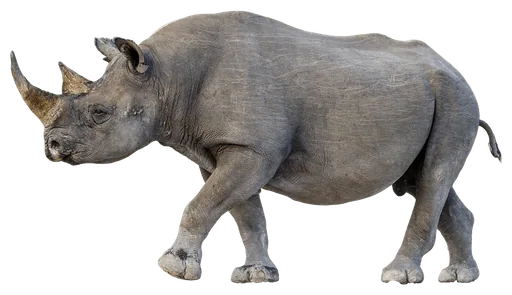
Faster than 57% of animalsThe black rhinoceros is a one-tonne African browser built around a long keratin horn, thick skin and explosive short-range power. A mature bull can close distance far faster than its size suggests and use its horn as a mass-backed lance, making frontal combat extremely dangerous. Its defenses come from body depth, toughness and scale rather than true armor. Strong smell and hearing compensate for weaker vision, while its hooked upper lip reveals its ecological specialty as a browser of shrubs and trees.
Detailed ratings
Research-backed ratings on one 0–100 scale for all 344 animals (updated 2026-09-27). How ratings work


Card No. 25 of 344. Every animal on Animal Battle Stats has one: its power, tier and archetype on the front; its six battle stats, abilities and signature move on the back.
Special abilities
The long anterior keratin horn concentrates a mass-backed rush into a penetrating or hooking point, giving the rhino exceptional frontal reach and injury potential.
Thick skin, huge body depth and a browsing ecology suited to thorny scrub let the rhino push through abrasive vegetation and remain difficult for ordinary teeth and claws to disable. This is toughness, not invulnerability.
Unique traits
The pointed prehensile upper lip selectively grasps leaves and twigs, separating black-rhino ecology from the grazing white rhinoceros.
Despite roughly 1.2 tonnes of mass, the species can produce short bursts around 50 km/h in authoritative natural-history accounts, making distance close surprisingly quickly.
How it fights
Weapons
- The primary weapon is the anterior keratin horn, backed by roughly 1.2 tonnes of body mass, a heavy skull and powerful neck/shoulder musculature. The posterior horn adds a second contact point and can matter during close pushing or hooking. The body itself is a weapon: a charge or short-range rush transfers far more absolute momentum than the attacks of medium carnivores.
Struggles vs
- No rigid armor or shell
- Eyes and other soft tissues remain vulnerable
- Limited fine manipulation and attack-angle flexibility
- Direct combat style is comparatively predictable
- Huge body mass reduces fine evasiveness
- Weight
- 1.2 t1.3 US tons
- Height
- 1.65 m5.4 ft
- Length
- 3.5 m11.5 ft
- Top speed
- 50 km/h31 mph
- Bite force
- No reliable measurement
- Lifespan
- 35 years
- Home biome
- Savanna
- Lifestyle
- Social
Rated specimen: ABS should use a healthy mature adult male.
Fun facts
- Black rhinos are not actually black; skin color is generally gray and often takes on the color of local soil or mud.
- The 'black' versus 'white' names do not describe true body color; lip shape is the much more useful field distinction.
- Their front horn commonly exceeds the rear horn and exceptional individuals can grow horns well beyond one meter.
- Rhino horn is compressed keratin, the same basic protein family found in hair and nails.
- A roughly one-tonne black rhino can sprint at road-vehicle speeds for short bursts.
- Black rhinos have no front incisors and rely heavily on the prehensile lip to bring browse into the mouth.
Closest rivals by power. Tap one for the full breakdown, or pick any opponent.
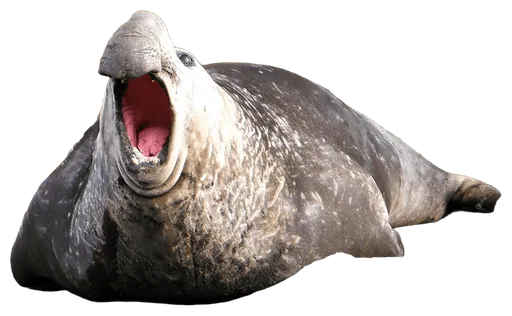
vs Kodiak BearWins · 55% · Toss-up 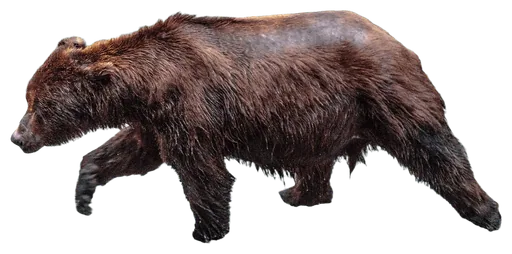 W vs Elephant SealLoses · 54% · Toss-up
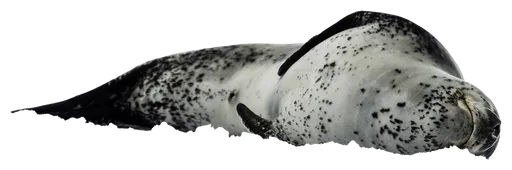
 L vs Leopard SealWins · 59% · Slight edge
 W vs Black CaimanWins · 59% · Slight edge
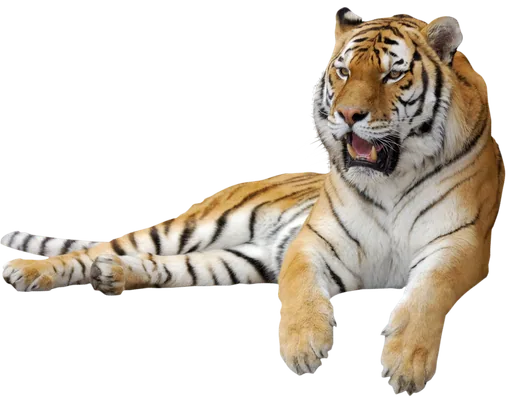
 W vs Siberian TigerWins · 57% · Toss-up
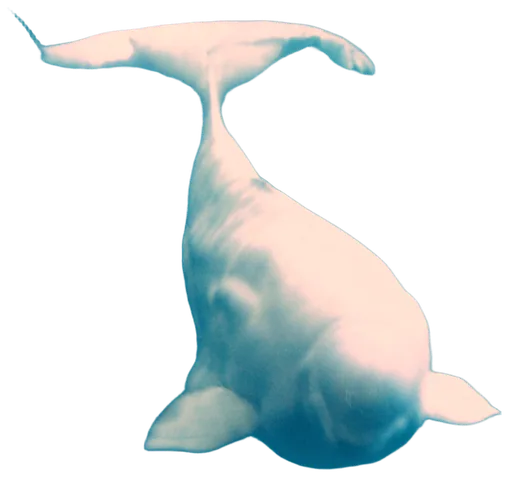
 W vs Beluga WhaleLoses · 52% · Toss-up
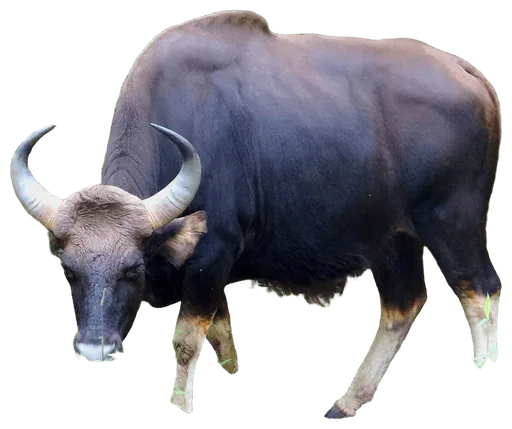
 L vs GaurWins · 55% · Toss-up
 W vs Bengal TigerWins · 56% · Toss-up
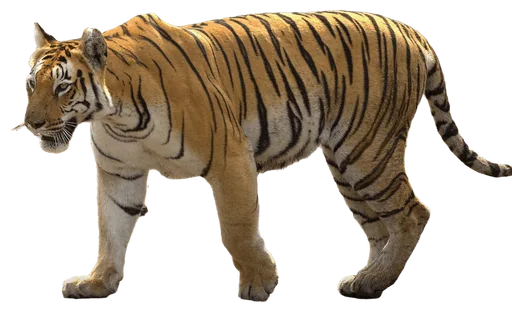 W
Black Rhinoceros battle analysis
A black rhino is best understood as a mobile terrestrial battering system rather than a slow armored tank. The canonical ABS bull weighs about 1.2 tonnes, yet authoritative natural-history sources place short bursts around 50 km/h. That combination of mass and rapid distance closing is central to its battle profile. The anterior horn, typically around half a meter but highly variable, creates a narrow contact point that can thrust, hook or gore. A second horn adds close-range redundancy.
Its Defense is similarly easy to misdescribe. The hide is thick and useful against thorns, abrasion and ordinary trauma, but it is skin rather than plate armor. The true defensive advantage is the complete package: large body depth, robust skeleton, heavy musculature, tough integument and an offensive horn that makes attackers pay for close contact. This is why healthy adults sit near the top of the terrestrial roster without approaching the several-tonne scale of an African elephant.
Behaviorally, black rhinos are not simply rage-driven animals. They maintain home ranges, communicate chemically and acoustically, and adult males may defend territories. Their weaker eyesight is compensated by strong smell and hearing. When a threat is judged close enough, however, the direct response can be a rapid charge. Intraspecific contests give adult males genuine experience delivering and avoiding horn attacks from similarly equipped opponents.
The species also carries one of conservation's starkest modern histories. Poaching drove black rhinos from tens of thousands to roughly 2,300 in the 1990s. Intensive protection and translocation helped the population recover to an estimated 6,788 by the end of 2024. That recovery is real but does not erase the Critically Endangered status or the continuing poaching threat.
Habitat & range
Black rhinos occupy grasslands, savannas, tropical bushlands, scrub and some desert-edge environments across fragmented parts of eastern and southern Africa. IRF currently reports the species in 12 African countries. Water, browse, wallows and salt licks influence home-range size.
Diet & hunting
They are herbivorous browsers, feeding on leaves, twigs, shoots, fruit, seeds and woody plants. The prehensile upper lip plucks vegetation. By browsing woody plants, black rhinos influence vegetation structure and function as major ecosystem engineers.
Social life
Adult bulls are typically solitary and may be territorial. Females and subadults can associate, and female ranges overlap more than the old 'strictly solitary' stereotype suggests. Scent marking, dung middens and urine are important communication tools.
Conservation
IUCN Red List: Critically Endangered. IRF's 2026 State of the Rhino reports an estimated 6,788 black rhinos at the end of 2024, up from 6,195 in 2022. The recovery from the roughly 2,300 animals left in the mid-1990s is substantial, but poaching remains the principal threat and the species is still far below historical abundance.
Quick answers
How strong is a Black Rhinoceros?
On the Animal Battle Stats scale, the Black Rhinoceros has an attack rating of 82 and a power index of 69.4 out of 100, which ranks it #25 of 344 animals and puts it in A tier (Elite). Its strongest stat is attack (82).
How much does a Black Rhinoceros weigh?
A typical adult Black Rhinoceros weighs about 1.2 t (1.3 US tons). Rated specimen: ABS should use a healthy mature adult male.
How fast is a Black Rhinoceros?
The Black Rhinoceros's top speed is about 50 km/h (31 mph). Its agility rating is 59 out of 100.
What does a Black Rhinoceros eat?
They are herbivorous browsers, feeding on leaves, twigs, shoots, fruit, seeds and woody plants. The prehensile upper lip plucks vegetation. By browsing woody plants, black rhinos influence vegetation structure and function as major ecosystem engineers.
Is the Black Rhinoceros endangered?
The Black Rhinoceros's conservation status is Critically Endangered. IUCN Red List: Critically Endangered. IRF's 2026 State of the Rhino reports an estimated 6,788 black rhinos at the end of 2024, up from 6,195 in 2022. The recovery from the roughly 2,300 animals left in the mid-1990s is substantial, but poaching remains the principal threat and the species is still far below historical abundance.
What animals can beat a Black Rhinoceros?
Among its closest rivals, the Elephant Seal (54%), the Beluga Whale (52%) would be favored against the Black Rhinoceros. It would be favored against the Kodiak Bear, the Leopard Seal, the Black Caiman, the Siberian Tiger, the Gaur, the Bengal Tiger.
Researched 2026-09-27. Ratings are editorial judgments built from these sources; measurements describe a healthy adult male.
- International Rhino Foundation, Black RhinoTaxonomy, range, mass, dimensions, horns, lifespan, ecology, reproduction, conservation
- IRF, 2026 State of the RhinoCurrent population trend
- Animal Diversity Web, Diceros bicornisMass, length, height, horn ranges, dimorphism, reproduction, longevity, behavior
- SANParks, Black RhinoDimensions, horn, skin, senses, browsing morphology
- World Land Trust, Black RhinoSex size/horn differences, lifespan, browsing behavior
- Potter Park Zoo, Black RhinoBurst speed cross-check
- Helping Rhinos, Black RhinoSpeed and dimension cross-check
- Smithsonian NMNH specimen Diceros bicornisHorn measurement reality check
- Wikimedia Commons, male Diceros bicornisImage provenance and whole-body candidate
Photo: “Diceros bicornis - profile - Etosha 2014.jpg” by Yathin S Krishnappa, CC BY-SA 3.0, background removed and cropped. Original
Suggest a correction